Get Full Government Meeting Transcripts, Videos, & Alerts Forever!
Get email alerts on the Local Impact Notes topic
No spam. Unsubscribe anytime.
School officials urge earlier, clearer local impact notes to avoid unfunded mandates
Summary
Representatives from the Minnesota School Boards Association and school business officials told the commission that mandates often arrive without reliable cost estimates or funding; they proposed an early local impact summary and a fiscal-clarification step to reduce unintended consequences for districts.
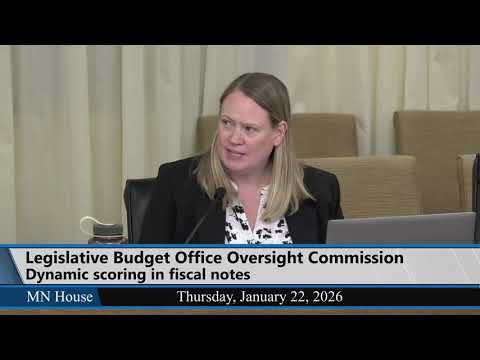
Representatives of Minnesota school districts told the Legislative Budget Office Oversight Commission on Jan. 22 that local governments and school boards often receive incomplete or late fiscal information about legislation that imposes new mandates.
Kim Lewis, representing the Minnesota School Boards Association, told commissioners that last year the association tracked 85 new mandates affecting school districts and urged the LBO to provide an "initial local impact summary early in the process," including a short description, section-by-section analysis, and a simple checklist of operational, staffing and fiscal benchmarks.
Tina Burkholder, director of business services for Monticello Public Schools, recommended adding a fiscal-clarification step that convenes a small, representative group of school finance officials with the Department of Education and legislative staff to develop a shared understanding of legislative intent and key assumptions before fiscal estimates are widely circulated.
Members and LBO staff discussed chronic problems: low response rates to local impact requests (about 30% reported), the difficulty school districts have providing timely, detailed estimates during busy budget periods, and trade-offs between breadth and depth of analysis. LBO Director Derek Lisonbee said the office currently receives between one and five local impact requests per session and that a brief early product followed by a deeper analysis on a small set of high-priority bills could be feasible under current resources.
Committee members asked staff to provide an example brief-plus-follow-up product so members can evaluate the approach and consider selective deep dives for high-priority bills rather than expanding the process for every proposal.
The commission then moved to public testimony.