Get Full Government Meeting Transcripts, Videos, & Alerts Forever!
Get email alerts on the Dynamic Scoring topic
No spam. Unsubscribe anytime.
Commission weighs dynamic fiscal notes as tool to capture long-term impacts
Summary
The Legislative Budget Office Oversight Commission heard a National Conference of State Legislatures presentation on dynamic fiscal notes and debated whether Minnesota should pilot dynamic analysis for areas with strong evidence, such as certain health and human services programs.
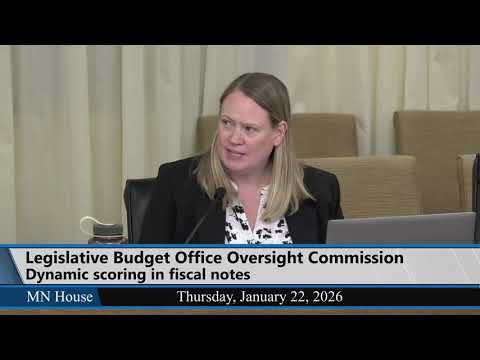
Erica McKellar of the National Conference of State Legislatures told the Legislative Budget Office Oversight Commission on Jan. 22 that dynamic fiscal notes attempt to quantify downstream economic effects of policy changes, and that several states have experimented with the approach.
McKellar, a fiscal affairs program specialist at NCSL, said dynamic analysis differs from traditional, or static, fiscal notes because it tries to account for behavioral changes and wider economic feedback. "Dynamic fiscal notes or dynamic analysis attempts to quantify the downstream effects of policy changes throughout the economy," she said.
The presentation summarized state experiences: about 21 states have tried dynamic scoring, often using REMI software; some, like Texas and Arkansas, have formal thresholds for when the analysis is required. McKellar noted Texas' 2009 statute requires dynamic statements for tax or fee measures with static estimates changing state revenue by $75,000,000 annually, while Arkansas recently set a $1,000,000 static-impact threshold and limited requests from chamber leaders.
Committee members probed applicability beyond tax bills. Senator John Marty said lawmakers in health and human services are interested in whether dynamic analysis would show net savings for interventions that reduce later costs, citing a bill that would cover home blue light therapy for newborns. "If it's covered at home, there can be a lot more people getting it at home," Marty said, suggesting that downstream savings could alter fiscal judgment.
LBO staff said fiscal notes already capture first-order, program-level savings if agencies can quantify them and LBO can validate the assumptions, but that higher-order, economy-wide effects are harder to measure and depend on strong supporting research. Derek Larson of the Legislative Budget Office said confidence in assumptions and data availability are key to whether an effect should be treated as a direct fiscal impact or a broader dynamic effect.
Supporters from the public urged a cautious, evidence-based pilot. Josh Berg of Accessible Space Inc. endorsed piloting dynamic fiscal notes in health-related programs where empirical evidence exists, such as community care hubs and PACE, and asked the commission to track accuracy over time.
The commission agreed to continue the discussion and to collect additional information on how peer states and the Congressional Budget Office handle dynamic scoring, with staff offering to provide examples of brief-plus-follow-up local impact products and other models the LBO could adopt.
The committee moved on to the next agenda item after the presentation.