Get Full Government Meeting Transcripts, Videos, & Alerts Forever!
Get email alerts on the Water Rates topic
No spam. Unsubscribe anytime.
Lucas Council accepts Raftelis study, directs ordinance for five‑tier water and wastewater rates
Summary
After a detailed presentation by Raftelis, the Lucas City Council accepted a five‑year water and wastewater financial plan and directed staff to prepare an ordinance to implement a new five‑tier rate structure; council set a public hearing for the first meeting in February 2026.
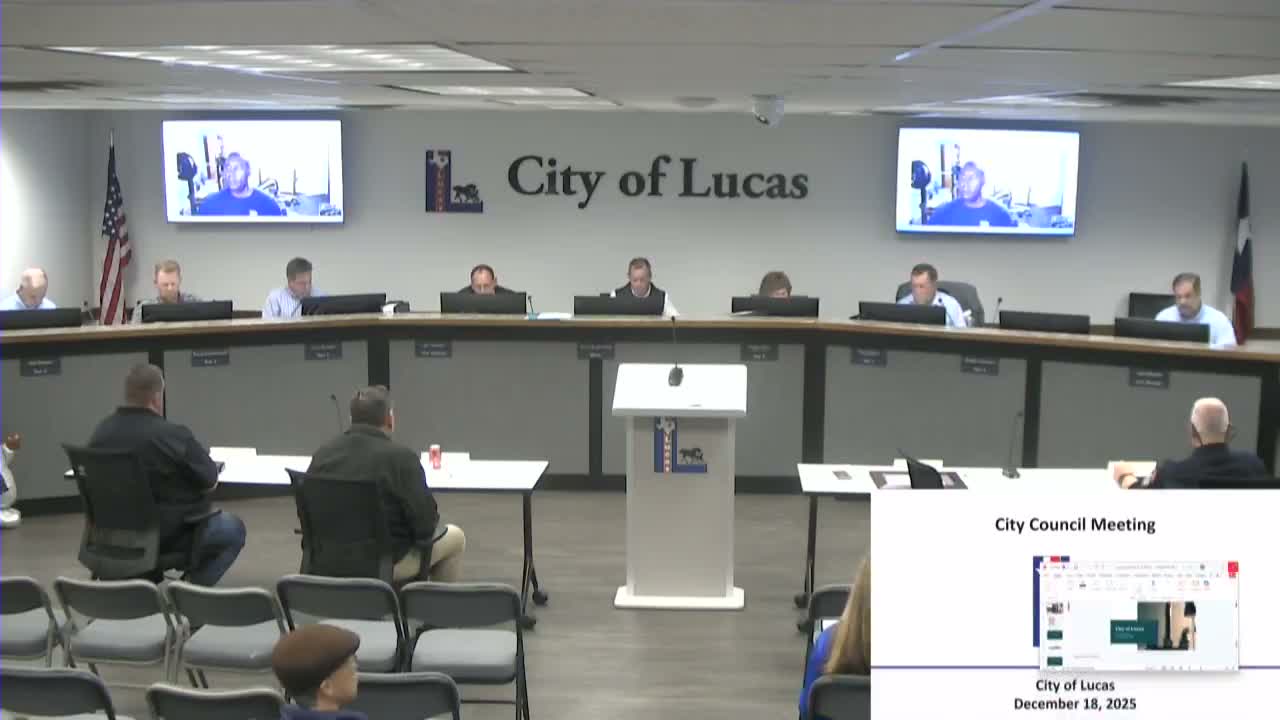
The Lucas City Council voted Dec. 18 to accept a water and wastewater rate study and five‑year financial plan prepared by Raftelis, directing staff to draft an ordinance to implement a five‑tier water rate structure and related wastewater charges and to schedule a public hearing at the council’s first meeting in February 2026.
The study, presented by Christopher Williams of Raftelis, recommended a 6% rate increase in 2026 (prorated to eight months, effective in February) and 6% annual increases thereafter, paired with a restructuring of fixed and volumetric charges into five tiers. Williams said the design is intended to align meter charges with industry standards, recover forecasted revenue needs and encourage conservation by shifting costs upward for very high users.
Raftelis’ forecast projects about 2,850 residential meters in fiscal 2026, growing roughly 1% per year, and estimated 659 million residential gallons of billed use in 2026 (about 684 million by FY2030). Williams flagged major cost drivers in the five‑year outlook: about $3.5 million in purchase‑water costs in 2026 (roughly $24 million over five years), $761,000 in building improvements in 2026, $5.6 million in cash‑funded capital over two years, and a proposed $9 million debt issuance in 2029. He noted Lucas currently holds reserves above policy targets and recommended a 180‑day cash‑on‑hand target and a debt‑service coverage policy of 1.25.
Williams said the rate design would reduce the typical monthly bill for an average inside‑city 1‑inch residential customer under the recommended structure while increasing bills for large users. "I'm recommending a 6% increase in 2026, which technically we've prorated in the model, so that that increase will go into effect 8 of the 12 months," Williams told council. He added that the new structure is designed so "as a residential customer continues to use more water, they're going to pay more."
Council members pressed on demand variability and scenarios for wet versus dry years; Williams said the analysis used a four‑year average including the recent wet year and that the model is available for annual updates. The presentation also noted potential future savings from moving onto the North Texas Municipal Water District’s new contract template but cautioned that some discounts are contingent on future developments.
After discussion, a council member moved to accept the Raftelis study, direct staff to prepare an ordinance amending Appendix C of the fee schedule to implement the five‑tier water structure (billing from the first gallon) and associated wastewater rates, and to schedule the required public hearing. Council amended the motion to set the public hearing for the first meeting in February 2026; the amended motion was seconded and carried unanimously.
Next steps identified by council included preparing the ordinance and public notice, incorporating the study’s analysis into the upcoming budget reviews, and using the model to validate assumptions annually. The public hearing and final ordinance will determine the effective dates for any rate changes.