Get Full Government Meeting Transcripts, Videos, & Alerts Forever!
Get email alerts on the Digital Safety topic
No spam. Unsubscribe anytime.
Maine Judiciary committee fast‑tracks bill to criminalize morphed and obscene AI‑generated child sexual images
Summary
The Judiciary Committee voted unanimously to report LD 524 'ought to pass as amended' with an emergency preamble. The amendment expands the definition of child sexual abuse material (CSAM) to cover morphed images that appear to depict identifiable minors and treats wholly AI‑generated non‑identifiable images as criminal only if obscene.
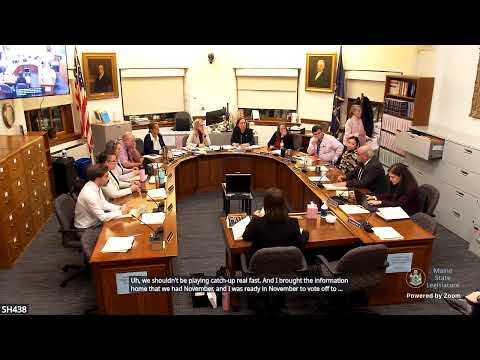
The Joint Standing Committee on the Judiciary voted unanimously to report LD 524 as amended and with an emergency preamble, adopting a sponsor amendment that expands Maine’s child sexual abuse material (CSAM) law to address morphed and AI‑generated imagery.
The amendment creates a statutory definition of CSAM that includes three classes: (1) images that depict an identifiable actual minor engaged in sexual acts (current law); (2) images that have been modified or morphed so they appear to depict an identifiable child engaged in sexual conduct; and (3) wholly computer‑generated images that appear to show minors, which would be criminal only if they meet an obscenity test (the Miller obscenity standard).
Janet (committee counsel) walked members through the drafting choices fashioned to reflect First Amendment case law. The change treats morphed images that are identifiable to a real child like traditional CSAM and requires prosecutors to prove obscenity before criminalizing wholly synthetic non‑identifiable images. The amendment also updates evidentiary rules, including a revised permissible‑inference threshold for dissemination intent when a defendant possesses a large number of distinct CSAM images (the amendment sets that inference at 100 images).
Law enforcement urged urgency. Lieutenant Jason Richards, commander of the Northern New England Internet Crimes Against Children task force, said investigators are already encountering morphed and AI‑generated material and that defenses challenging whether a depiction is of a real child are arising. "Yes. So we are already seeing this," he told the committee, describing capacity limits (six full‑time positions with vacancies) and a triage system focused on the youngest victims.
Prosecutors and the Attorney General’s office supported narrowly drafted language that aligns with federal precedent. Assistant Attorney General Andrew Bergen briefed members on the Ashcroft v. Free Speech Coalition decision and explained why morphed identifiable‑child images can be treated differently from wholly synthetic images under existing First Amendment doctrine: "When images involve actual children or identifiable children who were harmed in production, they are unprotected; wholly synthetic depictions implicate different First Amendment analysis and must meet obscenity standards to be criminalized."
Committee counsel and stakeholders flagged technical edits and potential vagueness concerns and preserved narrowly tailored institutional exceptions for purely educational, scientific, or law‑enforcement training uses. Sponsor Representative (sponsor) moved the bill with an emergency preamble; the committee voted 12‑0 in favor (2 absent) to report LD 524 'ought to pass as amended' with an emergency preamble so law enforcement can use the statute promptly.
Next steps: the bill will go forward with the committee’s amended language; stakeholders (prosecutors, defense bar, civil‑liberties groups) were encouraged to provide technical clean‑ups during language review to minimize vagueness and First Amendment exposure.