Get Full Government Meeting Transcripts, Videos, & Alerts Forever!
Get email alerts on the Winter Operations topic
No spam. Unsubscribe anytime.
NDOT outlines expanded winter operations, new trucks and real-time route tracking for Nashville
Summary
NDOT deputies told the Transportation & Infrastructure committee they expanded winter service to 80 routes, added dozens of trucks and introduced Samsara real-time tracking to improve accountability and route verification ahead of expected winter weather.
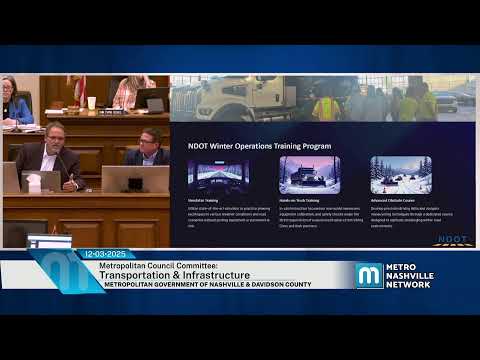
NDOT officials outlined a stepped-up winter operations plan to the Transportation & Infrastructure committee on Dec. 11, describing more routes, added equipment and new technology to improve response during snow and ice events.
Philip Jones, deputy director for the National Department of Transportation, said the department expanded its coverage to 80 routes, adding 387 lane miles and 192 route miles to the winter network. Jones said the department increased truck capacity with 48 salt trucks (including 34 new V‑body trucks), 31 route trucks, 14 standby trucks, two brine tankers and one mobile brine maker. Storage figures cited included about 100,000 gallons of brine, 30,000 gallons of calcium chloride and roughly 9,000 tons of road salt.
Jones described technology upgrades meant to improve operational accountability: the department deployed Samsara for real‑time coverage mapping and turn‑by‑turn routing, enabling staff to see which streets have been treated and to verify service. "Samser[a] real time operations, that's a coverage mapping," Jones said, and council members in the room confirmed the platform is active this winter. The department is also using in‑cab navigation, two‑way communications and automated verification tools to adjust routes dynamically during events.
Officials described two pilot programs: downtown sidewalk clearing using four Polaris Rangers and 29 light‑duty snow plows, and a neighborhood route pilot that allows a "plow in, plow out" approach without salt on certain smaller streets when accumulations reach four inches or more. Jones said crews prioritize essential mobility — downtown business district access, hospitals, emergency routes and public transit corridors — and aim for "dry pavement status" on priority routes as an aspirational goal.
During Q&A, Council member Allen Parker praised the presentation and confirmed Samsara's deployment. Parker asked whether the city had snow attachments for smaller maintenance vehicles used on bike lanes; NDOT said those attachments are not in service now but the department is evaluating future pilots. Members requested copies of the presentation; the chair indicated materials and recordings are available through Metro Nashville network and nashville.gov.
What this means for residents: the department has increased resources and introduced tracking tools to provide better transparency and route verification during winter storms, while piloting sidewalk clearing in high‑impact downtown areas. The city will continue to refine how small streets and bike lanes are cleared as the pilots and evaluations proceed.
Next steps: NDOT will operate under the expanded routing and equipment posture for the winter season and will provide data and post‑event verification through Samsara and other reporting tools.