Get email alerts on the Administration topic
No spam. Unsubscribe anytime.
Supervisors approve JAG grant, pavement-marking contract and certify small drainage election
Summary
On Jan. 26 the board affirmed a $35,611 JAG grant application for sheriff overtime and a drug-task-force position, approved county pavement-marking contract documents, canvassed a drainage-district election naming Corey Kelberg trustee, and approved routine minutes and payroll.
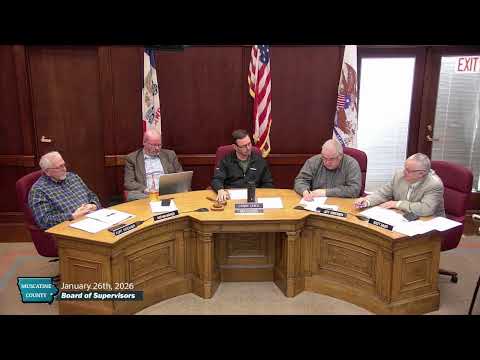
The Muscatine County Board of Supervisors took several administrative actions on Jan. 26, approving grant, contract and election items as part of routine county business.
The board affirmed an application for a FY26–27 JAG grant in the amount of $35,611 for the county sheriff’s office; supervisors said the funding supports overtime and one local drug-task-force position (shared with the city). The motion to affirm the application carried on voice vote.
County engineering staff presented contract, bond and certificate-of-insurance documents for project lM-26-1-73-70 (pavement markings on various county roads). Staff said the submitted contract documents were in order; supervisors approved the paperwork so it can be returned to the contractor and the work scheduled for late spring or early summer.
The county auditor reported results of the Jan. 17 Drainage District No. 2 election: two votes were cast and both votes selected Corey Kelberg, who the auditor declared elected trustee. Supervisors also approved the Jan. 19 meeting minutes and accepted the Jan. 26 payroll plan on motions and recorded ayes.
These items were carried on routine motions with no recorded opposition.
AI generated
The text on this page is AI generated. Summaries, highlights, analysis, and video transcripts are all produced from the original source material.
AI can make mistakes, so if you spot one, and we will fix it for everyone.
Note: the source content is unaltered by us. Any content source we link to, be it a video, an audio recording, or a document, is presented exactly as its publisher released it. That publisher is usually a government body, sometimes an individual official or another organisation.