
Committee advances bill requiring grant applicants to disclose long-term water savings
Get AI-powered insights, summaries, and transcripts
Subscribe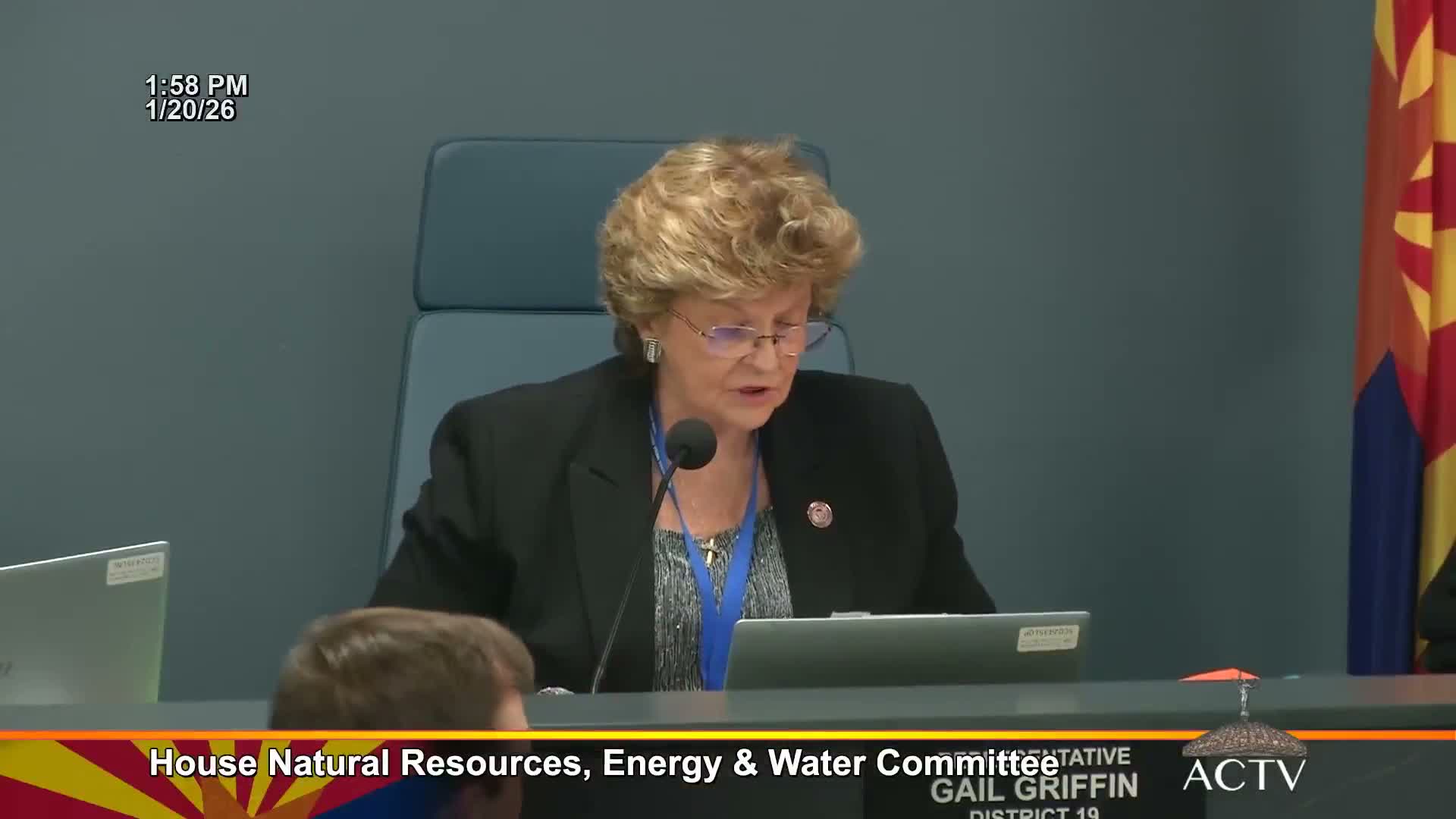
Summary
The House Committee on Natural Resources, Energy and Water moved House Bill 20 29 forward with a due-pass recommendation after WIFA testified the agency already collects most disclosure items; committee vote 9–1.
The House Committee on Natural Resources, Energy and Water on Thursday advanced House Bill 20 29, which would require applicants for the Water Conservation Grant Fund to disclose additional information about projected long-term water-use reductions and improvements in water reliability.
The measure was introduced by Corbin, who told the committee the proposal asks applicants to detail how grant funds would reduce water use and improve reliability over time. "We want to know what the long term reductions of water use would be," the chair said during discussion.
Judah Waxbaum, chief of government affairs for the Water Infrastructure Finance Authority (WIFA), testified WIFA is neutral on the bill and that the agency already requires applicants to disclose water savings and the supply being conserved under existing policy. Waxbaum also told the committee federal American Rescue Plan Act dollars previously funded 211 projects through the fund and that those projects conserved up to 6,600,000 acre-feet, a figure he provided to illustrate prior program scale. He said converting the agency’s existing application requirements into statute is "fine for us."
Members asked whether the fund can accept state as well as federal appropriations and whether adding statutory disclosure would create an extra burden on applicants; WIFA said the fund can be capitalized by either federal or state money and that the agency already collects about 90% of the requested information on its application, so the statutory change would largely formalize existing practice.
Vice Chair (addressing the committee) moved to return the bill with a due-pass recommendation. The committee approved the motion on a roll call, recording 9 ayes and 1 nay (Representative Pashlikai cast the lone negative vote). The bill will proceed with the committee’s recommendation.
The committee did not take additional amendments during the session.