
Arizona committee advances constitutional voting amendment after hours of testimony
Get AI-powered insights, summaries, and transcripts
Subscribe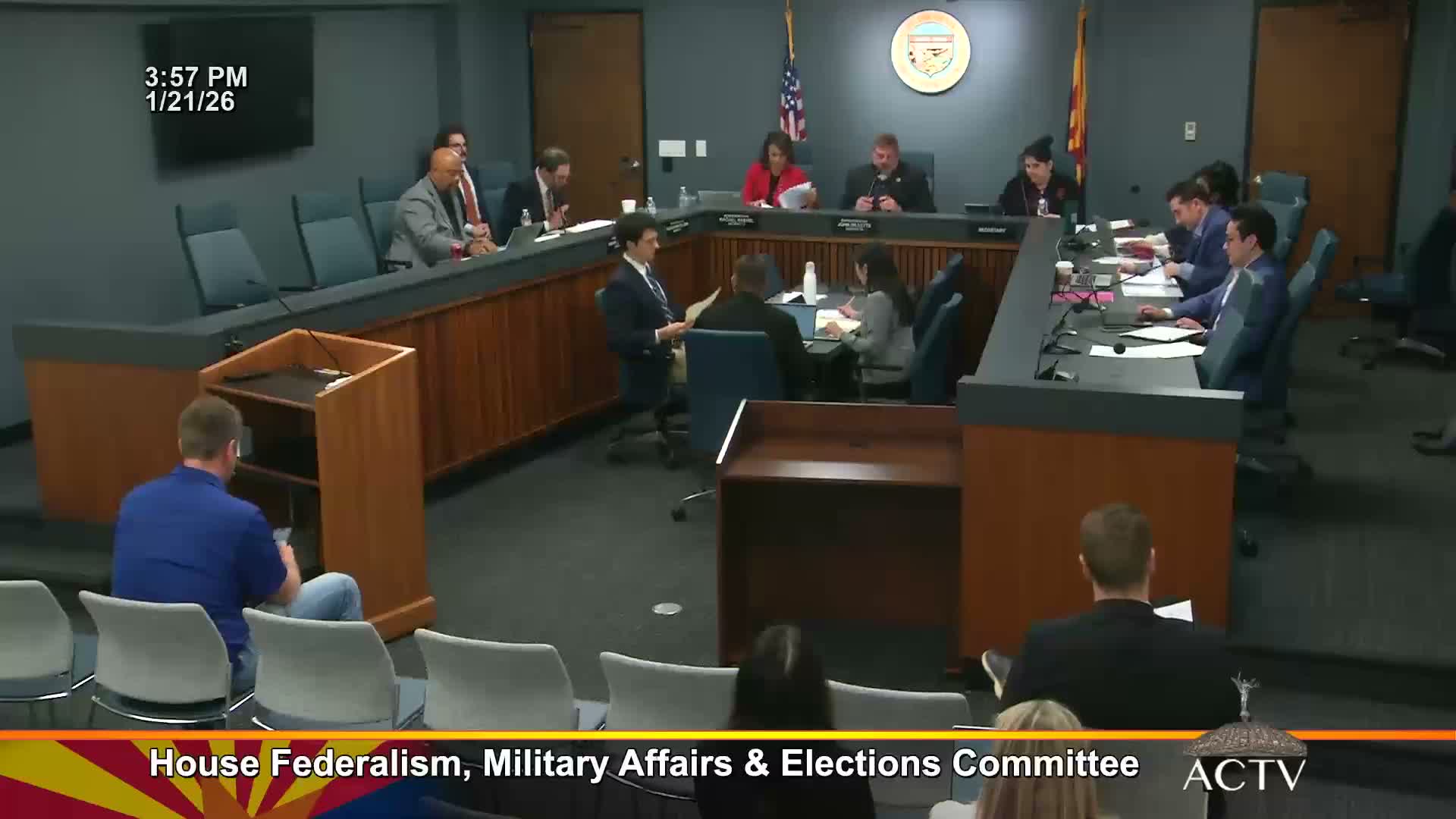
Summary
The House committee returned HCR 2,001 (a constitutional referral altering early voting, ID requirements, and ballot funding rules) with a 4–3 recommendation after extended testimony from county officials, advocacy groups, tribal leaders and the ACLU concerned about access and implementation.
The House Federalism, Military Affairs and Elections Committee advanced a constitutional referral (HCR 2,001) intended to change Arizona’s election rules, voting timelines and identification requirements, returning it to the House with a 4–3 due-pass recommendation on Jan. 20.
Sponsor Representative Alexander Collin described the referral as a package of “Florida-style” election reforms that would speed results, require periodic confirmation for mail-ballot recipients, limit late drop-offs and require government-issued identification to vote. Collin said the change would reduce erroneous ballots being sent to wrong addresses and improve public confidence and speed of tabulation.
Opponents — including the ACLU of Arizona, county recorders and tribal representatives — warned the measure would embed rigid, constitutional rules that could reduce access and be hard to implement. Jen Morrison of the Arizona Association of Counties told the committee the referral omits age and residency language found elsewhere in the constitution and raised concerns with the phrase “concurrent with casting a ballot” for ID verification in mail-ballot contexts. The ACLU’s Caitlin Contreras said the referral “does not improve election integrity” and that ambiguous ID language and a shortened weekend for early in-person drop-off risk rejecting lawful ballots.
Several county election officials and the Navajo Nation representative said the proposed timeline changes — notably ending certain early voting and drop-off options earlier — could disproportionately affect rural, tribal and working voters who rely on weekend windows. Supporters, including some county supervisors, said the changes are needed to preserve time for recounts and to ensure UOCAVA ballots destined for voters overseas are produced and mailed in a timely way.
Committee members split; proponents argued the measure balances access and administrative improvement and leaves multiple avenues available for voters, while opponents pointed to potential disenfranchisement and the difficulty of adjusting election administration on short notice. Representative Collin said the amendment includes mechanisms to verify and update voter addresses and would still allow several methods for casting ballots; Jen Morrison and others said clarifying statutory implementation would be essential before sending a permanent constitutional change to voters.
What happens next: Because this is a constitutional referral, if the House votes to pass it on the floor it would appear on the ballot for voters to decide. Committee action means the measure will go to the House schedule; the testimony indicates substantial floor debate and potential amendments ahead.