Get Full Government Meeting Transcripts, Videos, & Alerts Forever!
Get email alerts on the Transportation Masterplan topic
No spam. Unsubscribe anytime.
Guadalupe County reviews updated master thoroughfare plan; budget and property‑notification concerns raised
Summary
At a Feb. 11 workshop the Guadalupe County Commissioners Court reviewed a revised master thoroughfare plan from consultant Dawson, heard that the project has spent $288,000 of a $313,000 budget, and agreed to pursue public meetings in spring while residents pressed for earlier, direct notice and for clearer cost estimates of land acquisition.
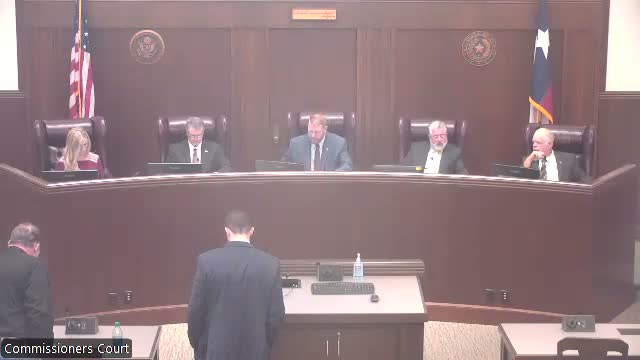
Guadalupe County Judge opened a workshop Feb. 11 to review the county’s draft master thoroughfare plan and next steps for public outreach. Grant Webin, a consultant on the project, said the team has completed draft mapping and coordination with neighboring cities and recommended moving the draft to public meetings in April and May with public notice planned for March.
Webin described a technical pivot that occurred after reviewing the initial grid approach: the consultants reworked the plan to prioritize existing arterials and to avoid partial‑boundary and environmental constraints. He listed major corridors under review — including FM 1101, FM 78, US 90, I‑10, SH 123 and SH 46 — and described typical cross sections the plan uses: collectors (about 90 feet of right‑of‑way), major thoroughfares (about 120 feet) and principal arterials (about 150 feet). Webin said the parkway cross section is still being finalized, likely in the 200–250 foot range.
On the project’s finances, Webin told the court that the total contract budget was $313,000. He said the county had spent $288,000 to date, up from the $192,000 figure discussed in March 2024, leaving roughly $24,000 remaining; about $18,000 of that is earmarked for direct public‑meeting expenses (venues, supplies through PCI) and the consultant team has roughly $6,000 left for labor under the current budget. "Our total budget was $313,000...spent to date is 288,000," Webin said.
Commissioners pressed the consultant for details about the work done between the March 2024 and current totals. Webin said the team substantially reworked the plan — effectively restarting the effort to replace an automatic grid with a more detailed arterial‑led design — and that each new or revised alignment required parcel‑level reassessment to minimize impacts, which increased hours and costs.
Court members agreed on a near‑term process: staff and consultants will draft a definitive scope of work for any remaining tasks so the county can obtain firm pricing, and the court will seek to post public notice in March and hold PCI‑assisted public meetings in April–May. Webin said PCI estimates 60–75 days lead time for a public meeting and the consultant is aiming for final plan approval in July if public comments don’t require major rework.
During public comment, long‑time resident Bob Etlinger urged the county to do more direct outreach to landowners whose properties lie under proposed dotted lines on the draft maps, saying many will be unaware of the planning effort and of potential future right‑of‑way impacts. "There's nothing that requires the governmental body in the planning stages at the front end to notify all these people whose properties may be affected," Etlinger said, and he asked the county to provide cost estimates for acquiring property should roadways be required.
Several other residents said they were worried about loss of family farmland, noise, litter and changes to rural roads if new alignments are adopted. One public commenter asked the court to consider improving existing routes such as SH 46 rather than taking new land. In reply, the Precinct 4 commissioner said he had redrawn lines in his precinct to avoid bisecting properties where possible and emphasized the purpose of the thoroughfare plan is to identify where developers — not the county alone — will be required to dedicate future right‑of‑way as development occurs.
The court and consultants also discussed coordination with Seguin and New Braunfels to avoid mismatched road endpoints at city limits and noted the plan relied in part on a review of 212 plats to determine where limited collector roads would be needed for future development access.
The judge asked staff to work with consultants to produce a clear scope and cost estimate for the remaining work; if approved, the county will post public notice in March and begin public meetings in April and May, aiming for a possible approval in July. The workshop adjourned at 9:46 a.m.