Get AI Briefings, Transcripts & Alerts on Local & National Government Meetings — Forever.
Auditor General: Arizona's school interoperability systems uneven; procurement, statutory gaps risk taxpayer dollars
Loading...
Summary
The Auditor General's December 2025 special audit found that Arizona's School Safety Interoperability Fund produced patchwork results: vendors and systems varied, procurement often lacked competitive documentation, some non-public schools were connected contrary to statute, and ongoing operational costs risked agencies abandoning systems without additional funding.
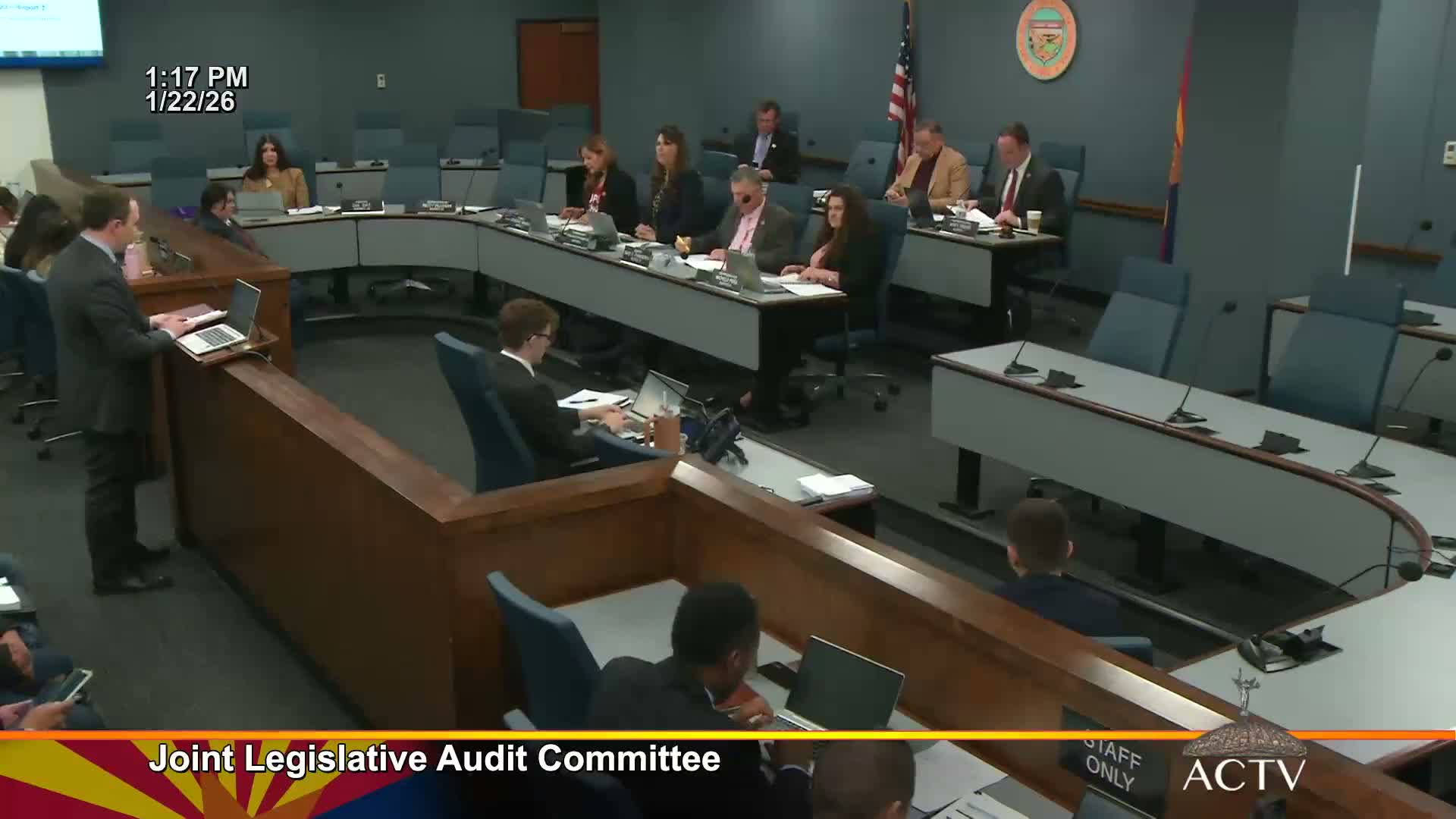
The Arizona Auditor General told the Joint Legislative Audit Committee that the state's program to fund interoperable school-to-public-safety communications has produced uneven results and left accountability gaps that the legislature should address.
"All 14 agencies had used fund monies to purchase interoperable communication systems, which was consistent with statute. But 4 agencies had allowed private or tribal schools, which are not public schools, to participate in their systems contrary to statute," Scott Swaggerty, director of the Auditor General's School Audits Division, said during the committee's hearing. He added the office estimated "each non-public school may have improperly received a benefit valued at about $17,000," but the auditors could not verify exact amounts because many contracts lacked detailed pricing information.
Why it matters: the audit found persistent weaknesses that could leave taxpayers paying for systems that either do not function as intended or entail long-term costs agencies are not prepared to meet. Since 2019 the state has allocated about $26 million to the School Safety Interoperability Fund and predecessor programs; auditors reviewed contracts that together totaled roughly $20.7 million and found about $13.6 million had been spent as of September 2025.
Key findings
- Technical and statutory mismatch: Auditors tested systems from three vendors (Mutualink, Motorola Solutions and Navigate360) and found none met every statutorily required function. In some cases vendors reported systems were "capable" of functions auditors could not independently verify. The office also flagged ambiguous statutory language (for example, the term "operational status") that produced inconsistent vendor interpretations.
- Restricted functionality in common deployments: Mutualink deployments commonly allowed school staff to trigger panic alerts but limited secure texting and file sharing to licensed users. "A teacher who called the incident would not have any such access," Swaggerty said, describing cases in which only licensed administrators could share images or files directly with law enforcement.
- Procurement and contract problems: Nine of 14 law enforcement agencies either did not follow applicable procurement policies or lacked documentation justifying sole-source awards. Auditors found agency contracts often lacked performance incentives, termination clauses, and detailed pricing, leaving agencies unable to hold vendors accountable or to estimate ongoing operating costs.
- Ongoing cost and sustainability concerns: Auditors estimated a rural county could expect annual ongoing system costs between about $16,000 and $382,000 depending on the system. Because the fund provided one-time allocations and not ongoing operations money, several counties risk running out of funds to keep systems functioning.
Recommendations and follow-up
The Auditor General urged agencies to determine and report any fund monies spent benefiting non-public schools, to adopt procedures preventing ongoing costs for non-public schools from being paid with fund monies, and to submit missed annual expenditure reports. The office recommended two legislative actions: clarify whether ARS 41-17-33 allows non-public (private and tribal) schools to participate and revise statutory requirements that produced mixed interpretations or that law enforcement said were not essential to emergency response.
What's next
Committee members asked counties and vendors to return with failure analyses, lists of participating and non-participating schools, and updated implementation plans. The JLAC scheduled a follow-up to review vendor responses and county March updates. "Before we vote on more money for this program, we have to have these stakeholder meetings to sort out details," the committee chair said at adjournment.