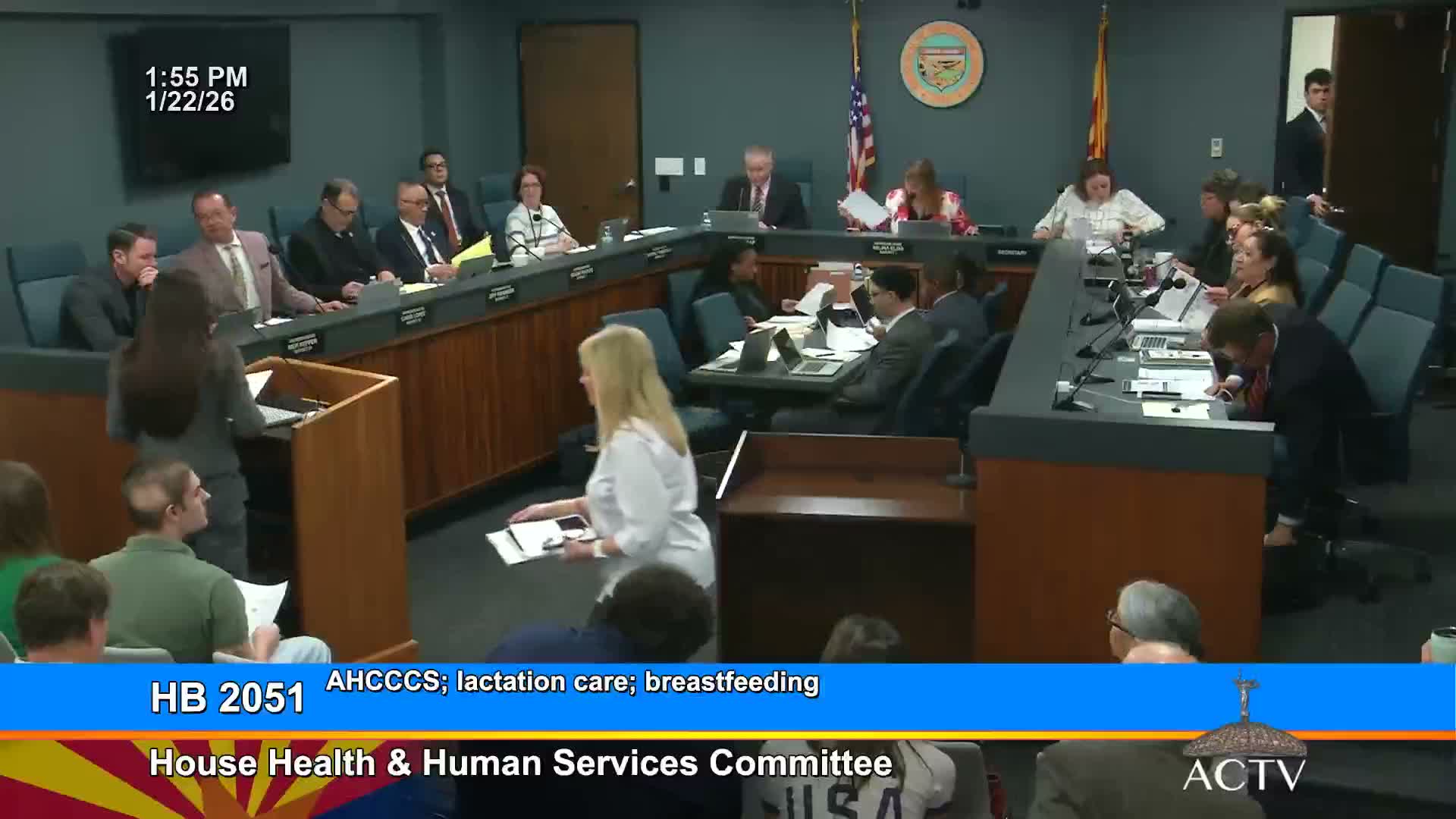
Committee backs bills to cover lactation services for Medicaid enrollees and create state certification pathway
Loading...
Summary
The committee adopted a CMS‑contingent amendment and returned HB 2051 (coverage of breastfeeding and lactation services under Access) and HB 2072 (optional state certification for lactation providers) with due-pass recommendations after extensive testimony from clinicians, tribal and indigenous advocates, and parents describing maternal and infant health benefits and access gaps.
Ajani explained two linked measures: HB 2051 would require Access (Arizona Medicaid) to reimburse breastfeeding and lactation services, subject to CMS approval per the sponsor’s amendment; HB 2072 would establish an optional state certification for lactation care providers under ADHS, with application, qualification, fee and disciplinary standards and a community advisory committee.
Sponsor Representative Lisa Fink framed the bills around public-health benefits and disparities: breastfeeding reduces infant illness and maternal morbidity, and low-income mothers have much lower breastfeeding continuation rates. Scientific and lived-experience testimony came from Dr. Lori Wood, Kimberly Morselles (Navajo Nation IBCLC and maternal mortality review co‑chair), Michelle Bonet and several parent advocates and advocacy groups (Phoenix‑Gilbert Chamber of Mothers). Access (Damien Carpenter) testified neutral while developing fiscal estimates and supported the CMS‑contingent amendment that limits state exposure if CMS does not approve coverage.
The committee adopted the Bliss amendment to condition Access coverage on CMS approval and returned HB 2051 and HB 2072 with due-pass recommendations (votes recorded 12-0 in both cases). Sponsors said HB 2072 was a minimally disruptive, voluntary credentialing pathway intended to meet federal requirements for reimbursement without over-regulation of providers.