Committee advances bill to let trained technologists use particle accelerators at rural hospitals
Loading...
Summary
The House HHS Committee gave House Bill 2049 a due-pass recommendation after testimony from rural cancer clinicians who said allowing particle accelerator use under supervision at critical access hospitals will expand local cancer treatment and reduce patient travel. The bill applies to counties under 400,000 and includes safety protocols.
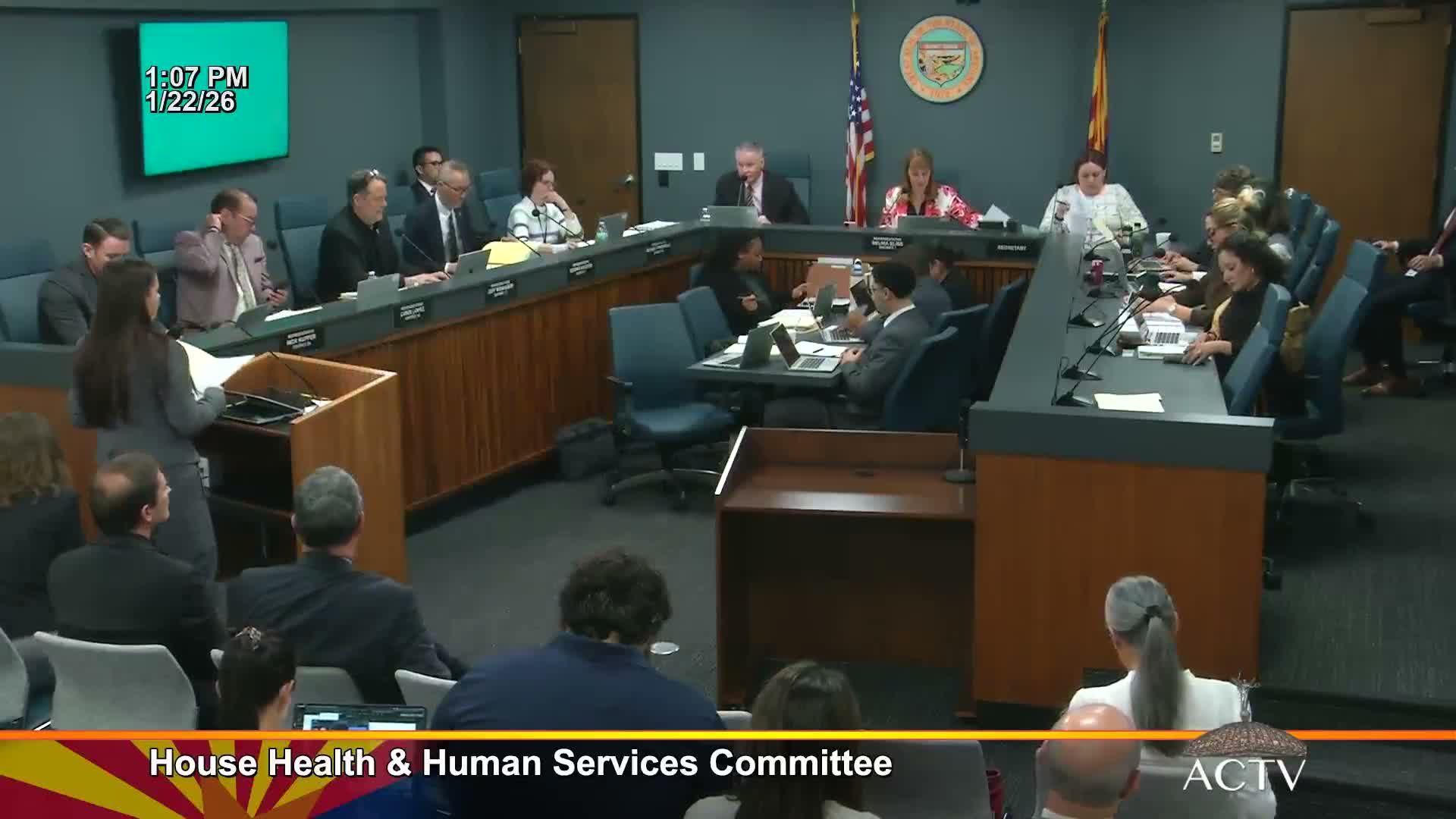
Representative Selena Bliss and committee staff described House Bill 2049 as an emergency measure to let particle accelerators be used for treating human disease at critical access hospitals and in counties with fewer than 400,000 people, with written protocols for supervision, radiation procedures and patient safety.
Logan Kilby, a committee research intern, summarized the bill’s scope and explained it was developed with the Arizona Department of Health Services and rural clinicians. In three supporting testimonies, clinicians described how rural oncology differs from urban practice. Dr. Seberzinski, who runs a rural cancer center in Bullhead City, said many states already allow similar measures and detailed why remote supervision and clear safety protocols can make local treatment safe and feasible. Dr. Van Love and Neil Jensen, a longtime rural hospital executive, said the measure would reduce long patient drives for care and align state rules with CMS standards.
Vice Chair (mover) brought the committee motion to return HB 2049 with a due-pass recommendation. The committee then conducted a roll-call vote; members voted 11 ayes, 0 nays, 0 present, 1 absent, giving HB 2049 a due pass recommendation.
The committee’s action now allows HB 2049 to proceed to the next legislative step; proponents said the emergency clause is needed to address imminent access issues in rural Arizona.