
Senate Education Committee recommends 10-year continuation for Credit Enhancement Eligibility Board
Get AI-powered insights, summaries, and transcripts
Sign Up Free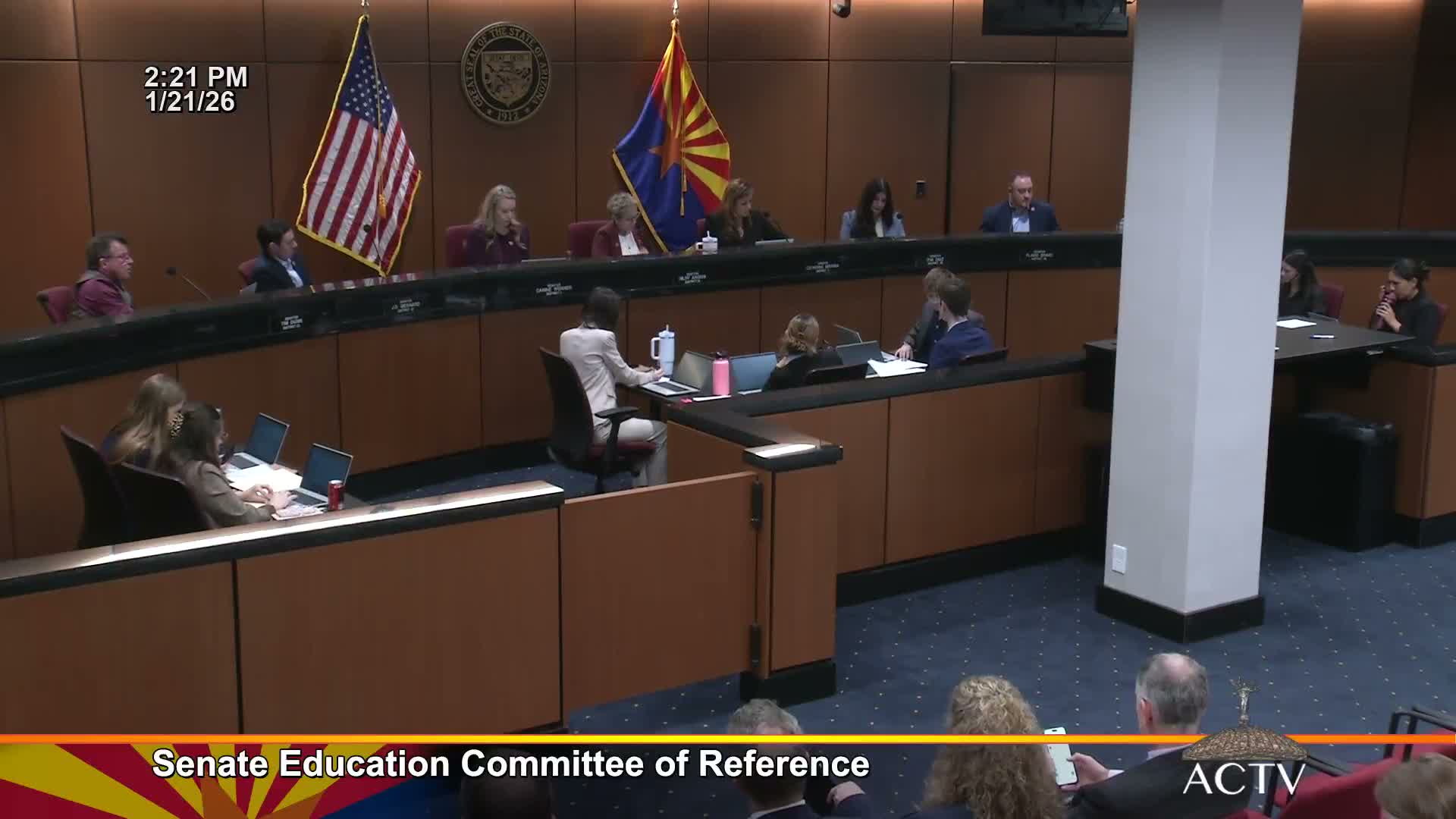
Summary
The Arizona Senate Education Committee voted to recommend a 10-year continuation (to 07/01/2036) of the Credit Enhancement Eligibility Board, which established a guarantee fund to lower borrowing costs for qualifying schools and has reached its statutory leverage cap.
The Arizona Senate Education Committee of Reference voted to recommend a 10-year continuation of the Credit Enhancement Eligibility Board, the panel overseeing a state guarantee that lowers interest costs for qualifying school financings.
Catcher Baden, director of legislative affairs in the governor's office, told the committee the board — created in the FY2017 budget — helps ‘‘lower the interest rates of qualifying schools so that they could have cheaper borrowing costs’’ by acting as a guarantee for approved school financings. Baden said the program’s statutory maximum leverage ratio is 3.5 to 1 and that the fund’s authorized capacity places the maximum approved financings at roughly $350 million.
Baden said the board has no dedicated full-time staff or separate administrative budget; support is provided through existing staff in the governor’s office, the treasurer’s office and the budget and policy teams as ‘‘other duties as assigned.’’ He told the committee the board has not met since 2022 because it has reached the maximum leverage ratio, but said it must remain available to meet and fulfill guarantees if a participating school were to default.
Senator Mesnard asked about financing maturities and demand for the program. Baden said most financed projects mature around 2050 and that approvals occurred over several years rather than in a single, first-come-first-served rush; he offered to review application records to determine whether additional applicants were turned away for capacity reasons.
A committee member moved to recommend continuation for 10 years, through July 1, 2036; the motion passed by voice vote.
The committee record does not show any amendment to the board’s statutory powers or a change in funding. The vote was a committee recommendation to continue the board; it does not itself alter statute or appropriations. The next procedural steps would be the committee’s recommendation report to the legislature and any follow-on bills or floor actions required to implement a formal statutory continuation.
Speakers quoted in this article are drawn from committee proceedings and include Catcher Baden, who presented for the governor’s office, and Senator Mesnard, who asked follow-up questions.