Get Full Government Meeting Transcripts, Videos, & Alerts Forever!
Get email alerts on the Comprehensive Plan topic
No spam. Unsubscribe anytime.
Tenino planning panel leans to preserve public zoning, use Ag Park overlay to protect agricultural identity
Summary
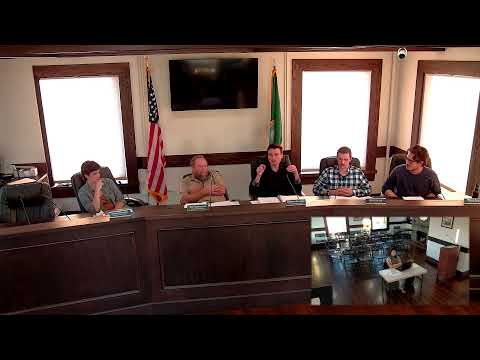
At its Aug. 13 meeting, the Tenino Planning Commission reviewed edits to the draft comprehensive plan and expressed a preference for retaining public/semi‑public underlying zoning for an Ag Park site while using an agricultural‑park overlay to allow targeted exemptions; commissioners asked the city’s economic development council for specific marketing feedback and debated climate and resilience policy language.
The Tenino Planning Commission on Aug. 13 debated whether to change a city‑owned Ag Park site from public/semi‑public zoning to light industrial, and members signaled support for keeping the public designation while using an agricultural‑park overlay to allow specific uses.
Unidentified Speaker 3 (Commissioner) moved that the commission recommend “Option 1” — retaining the public/semi‑public underlying zone and relying on the Ag Park overlay for exemptions — saying the overlay would “eliminate a lot of the permitting issues” and preserve the park’s agricultural identity. The motion is recorded in the transcript but the meeting record provided does not show a roll‑call vote or final tally on that motion.
Why it matters: commissioners said the choice will shape what kinds of businesses can locate in the Ag Park and how the site will be marketed. Supporters of keeping public/semi‑public zoning argued it reduces the risk of “use creep” — commercial or industrial activity that would shift the site away from its intended public, agricultural purpose — while still allowing the city to write exemptions for agricultural or Ag Park‑supporting tenants.
Discussion and staff guidance Staff explained an overlay can work two ways: by carving exemptions into the public/semi‑public zone or by layering restrictions on a light‑industrial zone so that industrial uses would fit the Ag Park’s aesthetic. Unidentified Speaker 7 (staff) told commissioners they can “write in that language” to permit containers and similar temporary or specialized structures for ag‑related uses, but noted that permanent‑structure rules (building code, foundations) would be decided by the building department.
Commissioners pressed for more information from the city’s Economic Development Council (EDC). Several said the EDC should provide examples of tenants lost or turned away by the current zoning and outline what kinds of tenants the city is trying to attract. “We need to have them tell us specifically what their issue is,” Unidentified Speaker 2 (Commissioner) said, describing the discussion as preliminary and asking staff to share the overlay language before a final decision.
Design, aesthetics and temporary structures A recurring concern was the site’s visual character: several commissioners said buildings should “look like siblings” — similar in style and palette — to support agrotourism, restaurants and event uses the city envisions. Commissioners asked whether container‑style businesses (for example, a mushroom grower operating from a container) could be allowed through overlay exemptions; staff said permitting and building‑code rules will control permanence, adding that overlays and design guidelines could preserve a consistent look.
Climate, resilience and other edits Commissioners used the meeting to review several climate and resilience policy edits in the draft comp plan. Proposed changes discussed included: - Replacing language that “requires” open‑space set‑asides with softer or alternative language such as incentivizing native, drought‑resistant landscaping (Unidentified Speaker 2). - Substituting a proposed sentence on emissions reductions during emergencies with a recommendation to adopt a comprehensive wildfire resilience plan; one commissioner said evacuation conditions make low‑carbon emergency transport impractical and recommended focusing on resilience planning instead. - Switching solar policy from a strict “require” for large rooftops to “incentivize” or require ‘solar‑ready’ design, with cost‑based exemptions suggested if panel installation would exceed a project cost threshold. - Adding language to reduce roadway flooding and to evaluate road elevation improvements in flood‑prone areas to reduce pollutant runoff.
Water and infrastructure Commissioners discussed reclaimed (“purple pipe”) water for irrigation and Ag Park uses and raised water‑capacity concerns. Staff and commissioners noted recent well and aquifer issues in the region; one commissioner urged including purple‑pipe and aquifer‑recharge language in the comp plan chapter.
Next steps and EDC involvement Commissioners asked staff to circulate the agricultural overlay language and the draft comp plan for review; staff said they will provide a clean and a tracked version and requested comment within two weeks. Commissioners also recommended inviting the EDC to present specific tenant/marketing examples so the commission can weigh concrete tradeoffs rather than general concerns.
Votes at a glance - Minutes (July): Unidentified Speaker 3 moved to approve the minutes as amended; Unidentified Speaker 2 seconded. Chair recorded a voice approval (“Aye”). - Recommendation on Ag Park zoning: Unidentified Speaker 3 moved to recommend Option 1 (retain public/semi‑public + Ag Park overlay); the motion is recorded but the provided transcript does not include a formal roll‑call or final vote on that motion. - Meeting reschedule/public hearing: Unidentified Speaker 3 moved to reschedule the Sept. 10 meeting to Sept. 17 and hold the comprehensive plan public hearing that night; Unidentified Speaker 2 seconded. Chair called for all in favor and a voice “Aye” was recorded.
The commission asked staff to send overlay language to the EDC and to circulate the draft for written comments before the next meeting. The rescheduled public hearing is set for Sept. 17.