Get Full Government Meeting Transcripts, Videos, & Alerts Forever!
Get email alerts on the Legislative Priorities topic
No spam. Unsubscribe anytime.
Spokane Valley council urges state support on public safety, housing and infrastructure; warns against more mandates
Summary
City officials pressed state legislators for help recruiting and training public safety staff, requested funding for crisis response and search-and-rescue helicopters, raised housing affordability concerns tied to state mandates and cited large transportation projects with multi-million-dollar funding gaps.
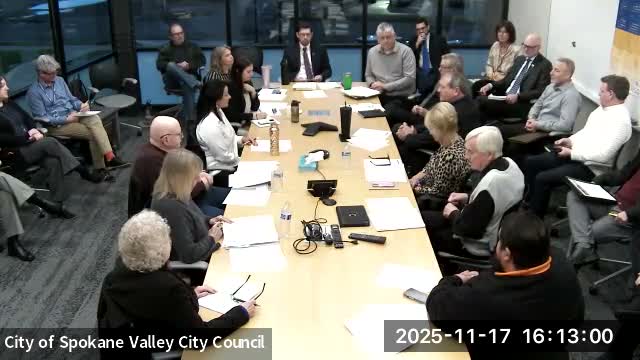
Spokane Valley officials used a Nov. 17 special meeting to press state legislators for a slate of priorities for the 2026 session, emphasizing public safety staffing, behavioral-health resources, housing affordability and major transportation projects that need state design and construction funding.
"Public safety isn't only about enforcement. It's also about developing resources to deal with the integrity fixing and experiencing work problems and mental health issues," said a policy presenter (Unidentified Speaker S3), outlining the city's priorities. The presenter said voters approved a public-safety sales tax that will begin collecting in January and that the city plans to add about 12 new public-safety positions, 10 of them officers, and asked the state for help with recruitment, training and access to state public-safety funding.
On equipment and statewide capabilities, the delegation said it supports a multi-county request for $10,000,000 to fund helicopters and units to operate across the state for search-and-rescue missions. The presenter also expressed support for regulated use of real-time camera systems while seeking records-access protections.
Speakers flagged housing affordability as a pressing concern, urging policies to lower construction costs and preserve existing housing stock. Council member Yeager asked the delegation to consider steps that reduce development costs and increase workforce training and apprenticeship programs for construction trades.
Transportation projects were raised as part of the legislative pitch. A presenter (Unidentified Speaker S6) described the Barker/I-98 interchange as an estimated $50,000,000 project with $400,000 of city funds already committed and asked for state design money. The presenter also said the Sullivan-area interchange has secured about $17,800,000 in design funding but remains roughly $80,000,000 short for full construction, and described the existing bridge condition as "structurally deficient, high risk."
Several council members stressed a broader theme of protecting local decision-making authority. One speaker asked the legislature to avoid additional mandates, saying city staff are already implementing a dozen new land-use mandates and that further changes complicate the city's comprehensive-plan update.
Speakers also warned of state fiscal pressures and increasing liability and litigation costs. Participants discussed the impact of project labor agreements (PLA), potential tax proposals (including income or wealth taxes and highway usage fees), and compliance and federal funding questions that may force program changes.
No formal legislative bills were voted on at the meeting. City staff will incorporate the items discussed into Spokane Valley's 2026 legislative package and pursue appropriations and technical fixes during the session.