Get Full Government Meeting Transcripts, Videos, & Alerts Forever!
Get email alerts on the Broadband topic
No spam. Unsubscribe anytime.
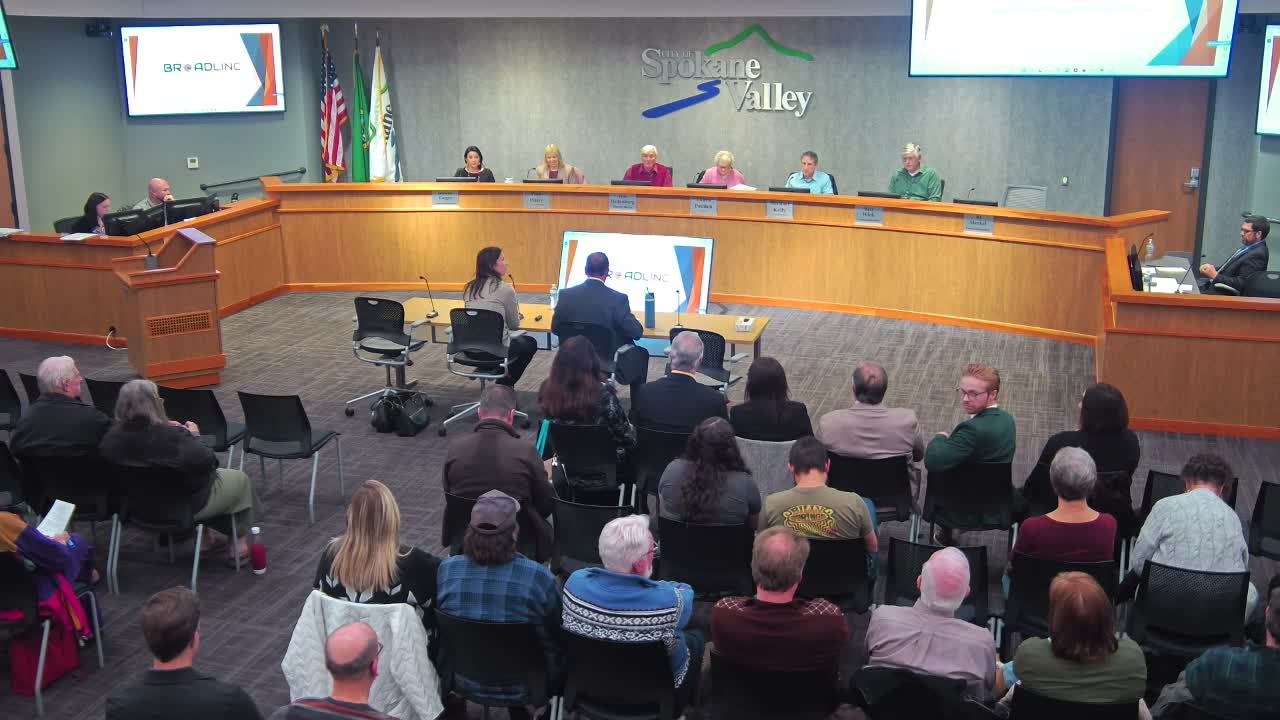
Council hears Broadlink presentation on BEAD awards and considers interlocal agreement for broadband
Summary
Broadlink officials told the council Spokane County has provisional BEAD awards covering roughly $90 million of the county’s $120 million allocation; council asked staff for more detail, discussed a potential board seat and asked Broadlink and staff to return with an interlocal agreement and specific benefits to Spokane Valley.
Broadlink, the Spokane County public-development authority for broadband, told the Spokane Valley City Council on Jan. 13 that it has applied for federal broadband funds and been provisionally awarded projects that could bring roughly $90 million of the county’s $120 million BEAD allocation to Spokane County.
Arion Schmidt, identified in the packet as Broadlink’s executive director, described Broadlink’s hybrid deployment model (fiber where feasible; fiber-to-tower and fixed wireless elsewhere), its role as a public incubator for public–private partnerships, and the organization’s strategy for sustainability: partner ISPs would pay recurring fees for dark fiber or wireless access that Broadlink said would support ongoing operations.
Schmidt said Broadlink applied to all 24 project areas in Spokane County and was provisionally awarded 13 areas, and the PDA has other federal and state grants underway (USDA, pilot programs, ARPA seed funding). She noted that BEAD has a deployment deadline of Dec. 31, 2029 and explained why the hybrid approach is necessary in a topologically challenged area.
Council members pressed for specifics about what Spokane Valley would receive and how a board seat would be assigned. Some council members said having a voice on Broadlink’s board is important because countywide decisions and large federal awards affect local residents and infrastructure. Questions included whether Spokane Valley would get a guaranteed at-large seat or a rotating seat, how the ILA would protect the city’s infrastructure and what local benefits (coverage, timelines, costs) would be guaranteed.
City Manager John Homan and staff offered to provide a more detailed analysis of the city’s existing ITS and utility assets and to work with Broadlink to clarify potential board representation, expected infrastructure investments in the Valley, and contractual terms. Council asked staff to meet with Broadlink, bring back more specifics on local benefits and board-seat options, and, if appropriate, return with an ILA for consideration.
No ILA was approved that night; the council indicated consensus to have staff and Broadlink supply more-definitive information and return with a clearer recommendation.