Get Full Government Meeting Transcripts, Videos, & Alerts Forever!
Get email alerts on the Critical Areas Update topic
No spam. Unsubscribe anytime.
Shoreline Council weighs major rewrite of critical-areas code that would expand 200-foot riparian zones
Summary
Council heard a staff presentation and public comment on Ordinance 1045, a Critical Areas Code update that applies WDFW guidance to create 200-foot riparian management zones in Shoreline — a change staff says would affect about 1,900 properties. Council asked staff to return with clarifications on native-planting requirements, how 'physically separated' areas would be treated, and whether the Deer Creek wellhead protection area should be designated as a CARA.
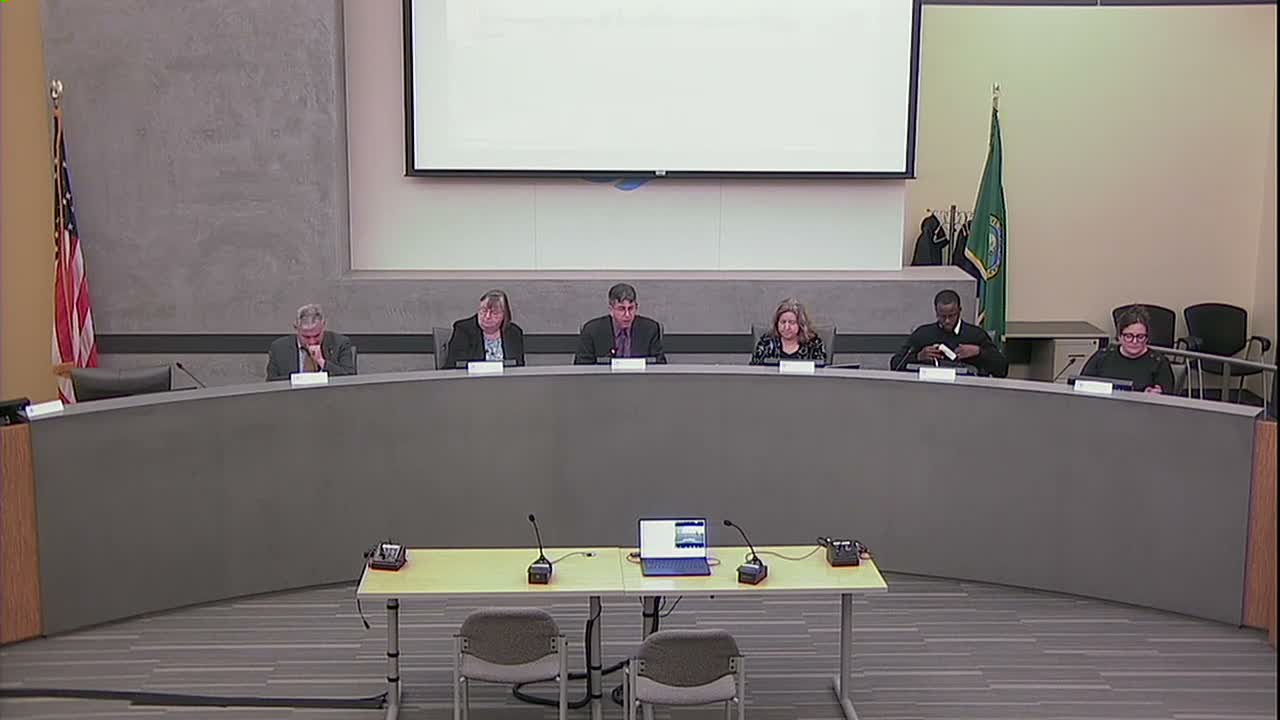
Shoreline — The Shoreline City Council on Nov. 24 received a staff briefing and public testimony on Ordinance 1045, a comprehensive update to the city's Critical Areas Code that would adopt Washington Department of Fish and Wildlife (WDFW) guidance and regulate riparian management zones using "site potential tree height." Planning Manager Elise Keim said WDFW's method yields a site potential tree height of 200 feet for Shoreline, translating to a 200-foot riparian management zone (RMZ) on each side of mapped streams and an estimated increase from about 1,400 to roughly 1,900 impacted properties.
Keim framed the update as a routine, state-encouraged periodic review under the Growth Management Act, but said the substantive change is the shift from variable buffers (previously keyed to fish presence) to RMZs based on tree height. "This is a pretty big increase in regulated critical areas in Shoreline," Keim said, noting the commission recommended using WDFW's RMZ width while retaining flexibility for developed properties.
Why it matters: Riparian zones influence stream health, pollutant removal and habitat function. Expanding regulated areas changes what property owners must show when seeking development approvals and may trigger planting, invasive-species removal and monitoring as conditions of any reduction.
Key proposals and staff policy tools
- RMZ width and impacts: Keim said the draft applies a 200-foot site potential tree height, producing a 200-foot RMZ on either side of streams and expanding the number of affected properties from about 1,400 to about 1,900.
- Allowable reductions: The draft would permit professional-assessed reductions in RMZ width of up to 25% for degraded or impacted areas, provided the remaining area is enhanced (plantings, invasive removal, monitoring) so the net ecological function improves.
- Physically separated/ functionally isolated areas: Staff described a policy that would allow areas determined by a qualified professional to be treated as "physically separated" or "functionally isolated" and therefore not regulated as a critical area if there is no ongoing ecological relationship. Councilmembers asked staff to clarify in the code what happens once an area is identified as separated, and whether restoration requirements or alternative rules should still apply.
- One-time expansion: The draft includes a concept allowing one limited, size‑restricted expansion of existing development that does not move closer to streams (Keim said the expansion must remain at least 100 feet from the stream), subject to a critical-areas report and mitigation. The city would avoid a longer Reasonable Use Permit/hearing-examiner process for those limited cases.
Public comment and interagency concerns
Three in-person speakers addressed the council. Ruth Williams of Thornton Creek Alliance urged the council to tighten Reasonable Use Permit processes and require variance applications to avoid large loopholes for projects in RMZs. Kathleen Russell, representing Safe Shoreline Trees, asked the council to require native trees and plants in enhancement plans and expressed concern about trail, bike and scooter impacts to tree roots and erosion. Bob Danson, general manager of Olympic View Water and Sewer District, urged the city to recognize the Deer Creek Wellhead Protection Area (WIPA) as a critical aquifer recharge area (CARA), citing district resolutions and a Watershed Protection Plan and warning that PFAS and urban runoff can contaminate shallow aquifers over many years.
Staff response and follow-up direction
Planning staff said they have met with Olympic View, the state Department of Ecology and the Department of Health to better understand roles and requirements. Staff's current reading is that a wellhead protection area can meet the CARA definition but is not necessarily a mapped CARA in the city's code; staff recommended continuing interagency conversations rather than automatically mapping the WIPA as a CARA in this update. Staff confirmed that enhancement planting plans must use site-appropriate native species at natural densities and that the city would record a one-time expansion in title notices and the city's permitting mapping software to prevent repeated use.
Council action and next steps
Council members said they want to protect drinking-water resources and pressed staff to identify options if CARA designation is not appropriate (for example, a memorandum of understanding or stormwater code mechanisms). Staff agreed to return with more detail and potential amendments; the council set a return timeframe around Dec. 15 and noted the code can still be amended in 2026 if unresolved.
What the council did not do: There was no ordinance adoption or final vote on Ordinance 1045 at this meeting; staff will present follow-up information and possible amendments at the next hearing.
Quotes
"This is a pretty big increase in regulated critical areas in Shoreline," Elise Keim, planning manager, said of the proposed 200-foot RMZ.
"Leaving the CAO unchanged leaves this drinking water resource unrecognized and unprotected," Bob Danson, general manager of Olympic View Water and Sewer District, said of the Deer Creek WIPA.
Next step: Staff will return to council with written responses to questions about native-planting requirements, the treatment of physically separated RMZs, and options for addressing the Deer Creek wellhead area; council indicated a target of Dec. 15 for the return presentation.