Get Full Government Meeting Transcripts, Videos, & Alerts Forever!
Get email alerts on the Critical Areas topic
No spam. Unsubscribe anytime.
Shoreline adopts revised Critical Areas Code, declines to designate Olympic View wellhead as CARA for now
Summary
The Shoreline City Council adopted Ordinance 1045 updating critical areas rules — including a new 200‑foot riparian management zone and clarifying language on when separated land is not regulated — and declined to immediately designate the Deer Creek Springs capture area as a critical aquifer recharge area, opting instead for stormwater code changes and further study.
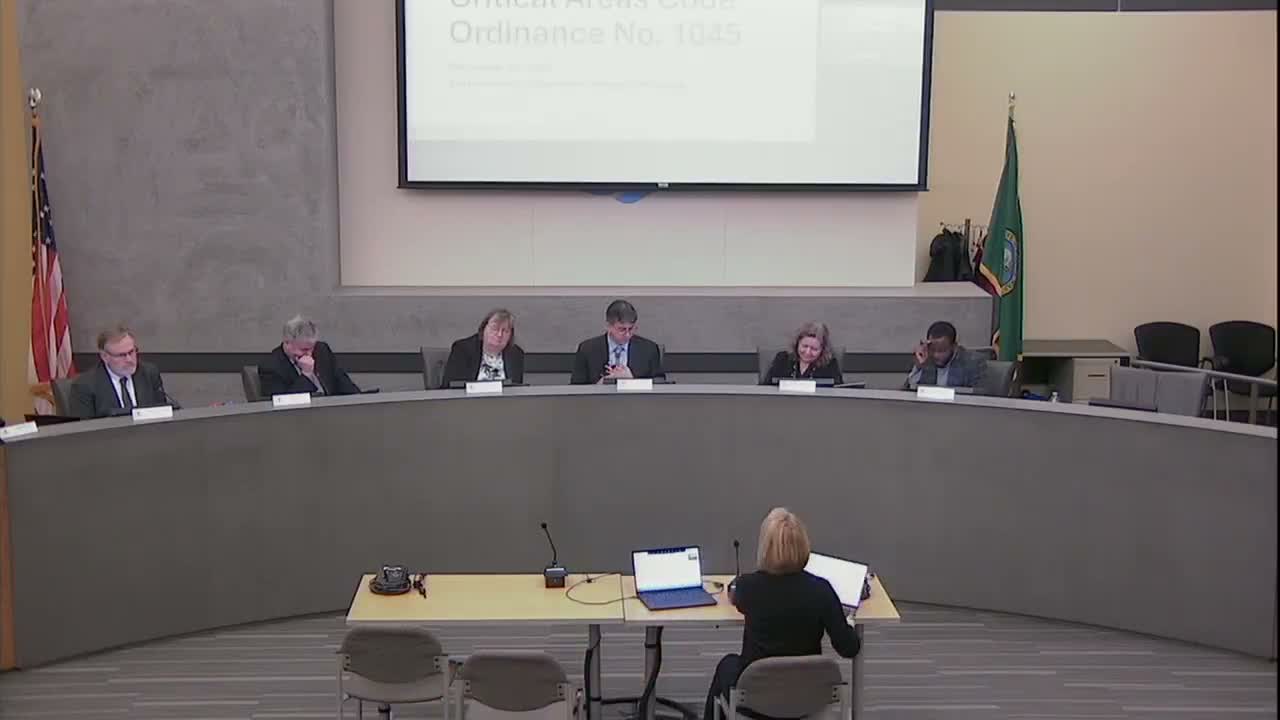
Shoreline City Council on Monday adopted Ordinance 1045, a comprehensive update to the city’s Critical Areas Code that replaces varying buffer rules with a 200‑foot riparian management zone in many cases, clarifies permit and mitigation requirements, and adds an amendatory motion clarifying when areas are "physically separated and functionally isolated" from a stream and thus not regulated as critical area.
Elise Kaim, the city’s planning manager, told council the riparian management zone is 200 feet wide and that the draft code includes flexibility for urban contexts, reductions for physically separated areas, clearer mitigation and native‑planting requirements, and public mapping for one‑time expansions. “This is a large increase in regulated critical areas in the city,” she said during the staff presentation.
The meeting featured an extended exchange about a Deer Creek Springs wellhead protection area that Olympic View Water and Sewer District asked the city to identify as a critical aquifer recharge area (CARA). Olympic View’s watershed protection plan maps a capture area overlapping about 43 Shoreline parcels; Bob Danson, the district’s general manager, urged the city to include the capture area in the CAO to ensure consistent protections.
Staff and council debated options including prohibiting deep underground injection controls in the mapped buffer, requiring hydrologic impact reports for redevelopment, and whether to apply different standards to the three commercial parcels versus the residential properties. Staff proposed instead to add a wellhead protection buffer section to the stormwater code (prohibiting deep UICs), map affected parcels, notify Olympic View for permit reviews, and enter an interim memorandum of understanding while the stormwater update proceeds in 2026.
Councilmembers voiced precaution about PFAS and drinking-water risks but were also mindful of the burden additional regulations could place on homeowners. The council adopted an amendatory motion clarifying the ‘physically separated and functionally isolated’ language without objection, and after further debate approved Ordinance 1045 as amended by a 6–0 vote. The decision leaves Olympic View’s CARA request unresolved; staff will continue discussions and bring stormwater‑code amendments and mapping back in early 2026 for more targeted rules.