
KCC warns SPP’s 2025 plan and rapid load growth will require major transmission investment
Get AI-powered insights, summaries, and transcripts
Subscribe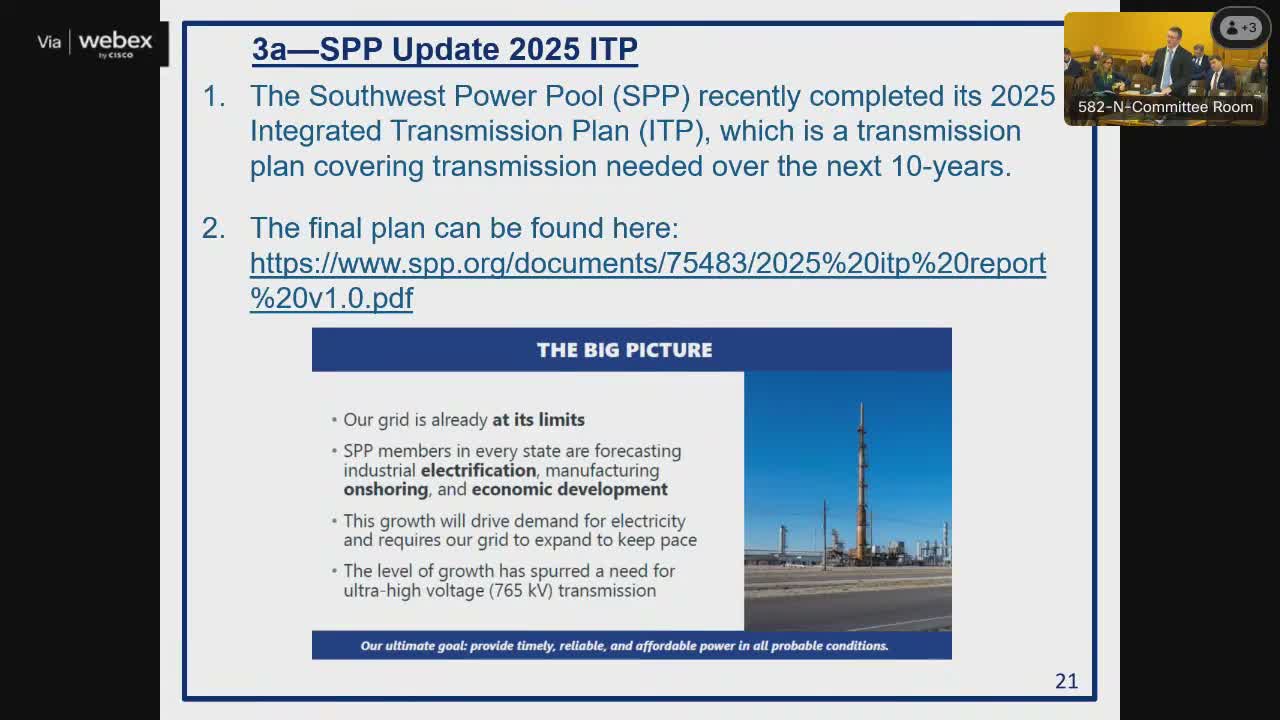
Summary
Justin Grady told legislators the Southwest Power Pool’s 2025 Integrated Transmission Plan initially proposed about $18.1 billion of projects and was trimmed to $8.5 billion of notices-to-construct after stakeholder engagement; he cited SPP modeling that showed demand growth (a 25% increase in MWh by 2030 and up to a 33% increase by 2034 in the base reliability model) and warned of serious load-shed risk without timely transmission investment.
Justin Grady, utilities division director at the Kansas Corporation Commission, told the committee that Southwest Power Pool’s (SPP) 2025 Integrated Transmission Plan (ITP) originally proposed roughly $18.1 billion in new transmission projects but, following stakeholder engagement and revisions, the board issued notices to construct totaling about $8.5 billion focused on near-term reliability projects.
Grady emphasized SPP’s rapidly changing load forecasts: he said the ITP’s base reliability model projects about 72 gigawatts of load by 2034 (roughly a 33% increase) and that spot or contracted “spot loads” could push the scenario to about 110 GW in more extreme futures. He cited SPP staff modeling that, without the proposed transmission build, a stressed scenario could produce dozens of load-shed days (Grady cited an extreme figure of 114 days in 2034 under a high-demand, no-build model) compared with the FERC reliability standard of about 0.1 day per year.
Grady explained that SPP’s modeling produced mixed results on household impacts: in a conservative production-cost-only evaluation the average residential impact would be about $2.99/month higher, while broader economic-benefit models showed about $5.31/month of average benefit in other scenarios — and that the net outcome depends on which portfolio and modeling assumptions are used.
He highlighted the 765 kV (spoken as “7 65 kV” in the presentation) conceptual overlay that would add high-voltage capability across the region and said the footprint- wide option could be substantially more expensive (he cited a range as high as $40–$60 billion for a full overlay) and would require extended stakeholder analysis. Grady said local routing and landowner concerns persist for projects such as the Buffalo Flats–Delaware line and the Holcomb–Sydney proposal and that staff testimony and route proposals are pending in applicable dockets.
The committee asked technical and geographical questions about benefits to Kansas and local areas; Grady said Kansas stakeholders were active in the SPP stakeholder process and had influenced the reduction from the original portfolio to the reliability-focused subset approved by the board. He closed by reminding members that Lanny Nicholff, SPP CEO, would present next Tuesday for a deeper technical briefing.