Get Full Government Meeting Transcripts, Videos, & Alerts Forever!
Get email alerts on the Indemnification Law topic
No spam. Unsubscribe anytime.
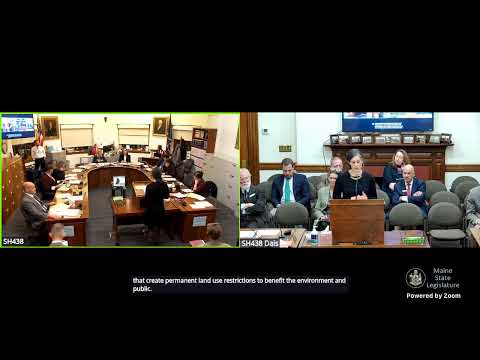
Maine committee hears dueling views on bill to limit indemnity clauses; businesses and landowners warn of broad consequences
Summary
Proponents urged LD 17 61 to block contracts that shift responsibility for another party's negligence to smaller contractors; supporters framed it as 'David versus Goliath.' Opponents—railroads, municipalities, insurers and recreation industries—said the amendment is overbroad, risks disrupting crossings, conservation easements and surety bonds, and recommended narrow, industry‑specific fixes.
Representative Morris presented LD 17 61 as legislation to prohibit contractual provisions that make a party responsible for another party's negligence, arguing such clauses shift accountability away from the party in control and burden small businesses. He described the bill's intent as preserving reasonable risk management — for example, insurance and naming additional insureds — while preventing coercive, one‑sided risk transfers.
Supporters from workers' compensation trusts and construction and transportation businesses said indemnification provisions are increasingly used by larger organizations to offload negligence liability onto smaller contractors. Joe Edwards, representing seven self‑insured workers' compensation trusts, summarized that framing as "David versus Goliath," describing cases and industry examples where small companies faced crippling exposure after signing broad hold‑harmless language under economic pressure.
Industry witnesses urged a targeted approach or amendments. Contractors and logging representatives testified that they are sometimes compelled to accept broad indemnity clauses to secure work. Brian Park of the Maine Motor Transport Association pointed to existing statute (Title 10 §1459) that voids indemnity provisions in motor carrier contracts and noted a drafting error in the amendment’s effective date (the bill text referenced 2026 as an effective date already passed).
Opponents — including large landowners, Maine DOT, railroad and freight interests, the ski industry, insurers, municipal groups and banks — warned the amendment as written would be a sweeping ban with many unintended consequences. Irving Woodlands and rail firms said private crossing, sidetrack and rail access agreements commonly include indemnities; the Downeaster passenger rail service and private crossing agreements rely on blanket indemnity provisions and could face increased insurance costs or contract renegotiations. The Maine Department of Economic and Community Development and the Bureau of Insurance cautioned that contractual allocation of liability is traditionally fact‑specific and handled by courts, and that a broad statutory prohibition risks shifting disputes into litigation and increasing costs.
Several witnesses proposed narrower fixes. Insurance and industry witnesses recommended limiting statutory change to specific high‑risk sectors (construction, snow removal, transportation) or clarifying exceptions for surety bonds, federally funded project bond conditions, recreation statutes and municipal contracts. Neutral witnesses and landowner groups highlighted conservation easements, recreation access and trail permissions that depend on indemnity language, and warned that removing these clauses could disincentivize public access and conservation agreements.
The committee closed the public hearing after receiving many pieces of written testimony and public comment. Lawmakers asked agencies and proponents for additional drafting work, data about the frequency and effects of coercive indemnity clauses, and suggested further work‑session negotiations on tailored exceptions and technical drafting.