Get Full Government Meeting Transcripts, Videos, & Alerts Forever!
Get email alerts on the Ld1005 Sprinkler Review topic
No spam. Unsubscribe anytime.
Fire marshal recommends keeping statewide sprinkler review while expanding staff; committee asks for bill and hears CO and thermal imaging proposals
Summary
The Office of the State Fire Marshal advised preserving a centralized sprinkler-review function, recommended hiring 2–4 plan reviewers to reduce backlogs, suggested a narrow municipal delegation under MOU and ALMS, and the committee voted to draft a committee bill; the committee also heard public testimony on LD 2012 (carbon monoxide detectors) and moved LD 2016 (thermal imaging repeal) to work session.
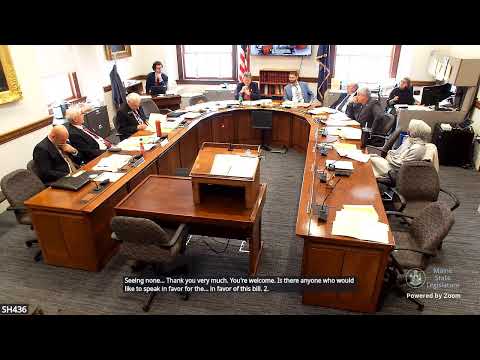
The Criminal Justice and Public Safety Committee heard a working-group report from the Office of the State Fire Marshal on whether municipal fire departments should be authorized to conduct sprinkler plan reviews.
State Fire Marshal Sean Esler told the committee the working group found that the state’s centralized sprinkler-review system was not the principal cause of permit delays; rather, construction-plan reviews had outpaced the fire marshal office’s capacity. The office’s reviewers handled roughly 1,600 plan projects in 2025 — about 800 sprinkler permits and about 800 construction permits — and, with current staffing, reviewers face heavy caseloads. The working group recommended retaining the State Fire Marshal as the central authority for sprinkler reviews to preserve uniform code application, while expanding staff and offering a narrow delegated-review pathway for municipalities that meet training and certification standards.
Recommendations the working group presented included: (1) add two to four plan reviewers to the fire marshal’s office (2 positions possibly funded from special revenue and 2 from general funds), which the report estimated would reduce average review times from approximately six weeks to as little as 1.5–4 weeks depending on hiring; (2) implement a controlled municipal-delegation program governed by a written MOU that limits delegated authority to trained municipal employees (not contractors) and retains state authority for high-risk occupancies; (3) use the agency licensing management system (ALMS) to centralize electronic permitting and visibility; and (4) establish regular QA/training meetings for delegated reviewers.
Committee members discussed funding and fee options. Representative Hassonfuss moved that the committee ask OPLA to draft a committee bill based on the working group's draft language and to include a proposed fee increase to fund staffing; the motion passed by voice/show of hands. Esler said the working group intentionally did not design a fee proposal in the short timeline but noted the fire premium tax and plan-review fee revenues can support two positions now; he warned that broad delegation without strict controls could fragment code interpretation statewide.
The committee then opened a public hearing on LD 2012, a bill to harmonize Maine’s carbon monoxide-detector statute with the NFPA life-safety code. Witnesses supporting LD 2012 included the National Electrical Manufacturers Association (NEMA), the State Fire Marshal, the Maine School Management Association (which asked for a funding mechanism for schools), and the Maine Fire Protection Services Commission. Testimony emphasized that NFPA-based detector placement better protects schools, daycares and multi-occupancy buildings than the statute’s current fixed minimums.
Representative Steve Bunker also presented LD 2016 to repeal an outdated thermal-imaging-camera statute. The state fire marshal said the program was created when cameras were new and expensive; today thermal imaging is standard equipment and the statutory program is unfunded and unnecessary. The committee voted to place LD 2016 in work session.
Next steps: the committee asked legislative staff to draft a committee bill based on the LD 1005 working-group language (including a proposed fee change to be developed in consultation with stakeholders) and set LD 2012 and LD 2016 for work-session consideration.