Get Full Government Meeting Transcripts, Videos, & Alerts Forever!
Get email alerts on the Zoning Group Homes topic
No spam. Unsubscribe anytime.
Fulshear planning panel recommends zoning changes to define and conditionally regulate group homes and residential care facilities
Summary
The Planning & Zoning Commission recommended approval of Ordinance No. 20 25-15 15 to add state-aligned definitions for group homes and residential care facilities, require conditional-use permitting and a 2,500-foot separation standard, while staff warned changes are legally complex because of federal and state protections.
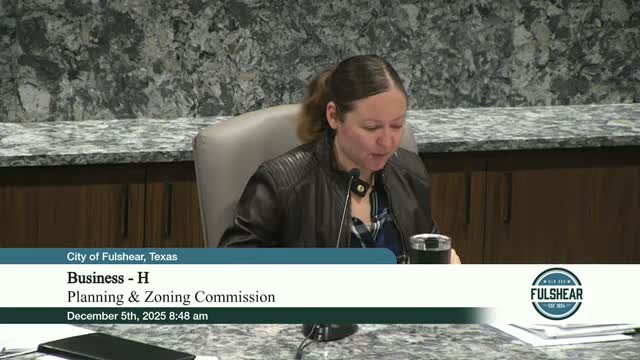
The City of Fulshear Planning & Zoning Commission on Dec. 5 recommended that the city council adopt Ordinance No. 20 25-15 15, a text amendment to Chapter 28 of the coordinated development ordinance that creates clearer, state-aligned definitions and conditional-use rules for personal care homes, group homes, community homes and larger residential care institutions.
Staff told commissioners the primary purpose is definitional clarity and permitting going forward, not to shut down existing operations. The ordinance would treat personal care homes (three or fewer residents), group homes (generally seven to 15) and community homes (small facilities serving people with disabilities) as residential uses that are allowed in certain residential districts only as conditional uses; residential care institutions of 16 or more residents would be regulated under standards similar to multifamily uses. Staff said proposed conditions include a permitting process, written notice to the city, architectural compatibility, parking requirements and a 2,500-foot separation from an existing community home.
Resident testimony highlighted neighborhood concerns. "My 8 year old daughter ... has to catch the bus literally 60 feet from this driveway. While kids in this type of facility will come out and have aggression and be hitting the fence, using the 'f-word' and the 'n-word,'" said local resident Herc Myer, who urged enforcement and limits on such facilities in residential zones. Myer said multiple recent police responses to a nearby residential treatment facility have "severely altered" his family's enjoyment of their property.
Legal counsel cautioned the commission that regulation is legally complicated. Charlie Zek, the city's legal adviser present at the meeting, said regulating these uses risks running into federal and state protections. "Regulating these types of uses is complicated," Zek said. "They have a broad protection under the Americans with Disabilities Act, and there is a lot of case law where folks have sued cities for overregulating or refusing these uses in residential districts." He and staff said definitions are intended to align with state licensing categories so the city can require conditional-use permits and design standards while minimizing legal exposure.
Commissioners asked whether the ordinance would force existing facilities to obtain permits if adopted; staff and counsel said it would not be retroactive — currently operating facilities would not be required to apply for a permit solely because the definitions change. Commissioners also discussed enforcement options such as nuisance fines or security requirements, but staff said broad mandates (for example, an across-the-board security requirement) would apply to other residential uses as well and could be difficult to defend legally.
Commissioner Clifford moved to recommend approval of Ordinance No. 20 25-15 15 and Commissioner Eman seconded; the motion passed. The ordinance will next go to the Fulshear City Council, which the staff notice said will hold a public hearing on Dec. 16 at 6 p.m. at the municipal complex.
What happens next: the city staff said it will continue vetting regulatory language with legal counsel and later bring additional wording (including an accommodation ordinance) to the city for further consideration.