Get Full Government Meeting Transcripts, Videos, & Alerts Forever!
Get email alerts on the Education Budget Sb29 Sb30 topic
No spam. Unsubscribe anytime.
Senate education subcommittee reviews SB 29 and SB 30: technical rebenchmarking, compensation and targeted investments
Summary
Staff briefed the Senate Education Subcommittee on SB 29 and SB 30 changes, citing a $207.8 million general‑fund reduction in SB 29 and a $678.3 million general‑fund net increase in SB 30 over the biennium, including a 2% annual compensation supplement, school construction funding shifts, and higher‑education investments.
Staff for the Senate Finance and Appropriations Committee presented an overview of the Governor’s introduced education budget and language amendments in SB 29 and SB 30, walking the subcommittee through technical rebenchmarking, proposed compensation supplements, and several targeted program changes.
Kendra, a budget staffer, told the panel that SB 29’s technical adjustments produce a net general fund reduction of $207,800,000 and a net increase of $48,300,000 in non‑general funds due to updated participation and lottery proceeds. She said SB 29 includes one policy change: a proposed 2% bonus for funded instructional and support positions effective June 1, 2026 (estimated at $106,500,000 general fund).
On SB 30, staff described a proposed net increase to direct aid of $678,300,000 general fund and $548,800,000 non‑general fund over the biennium, including $579,000,000 for initial rebenchmarking and technical costs and $382,900,000 to support a 2% compensation increase in each year for instructional and support positions. Staff also proposed supplanting $285,000,000 general fund with literary fund dollars for teacher retirement and allocating $299,000,000 non‑general fund for school construction (partly supported by projected casino revenues and literary fund transfers).
Staff noted language changes that would allow the Department of Education to withhold lottery funds from divisions that do not comply with annual school reporting requirements (effective FY 2028), require Board of Education approval for divisions to join existing governor schools with state funding subject to appropriation, and clarify eligibility for the School Construction Assistance Program so public, regional, and joint schools cannot be excluded. Kendra also detailed DOE and Virginia School for the Deaf and Blind adjustments including funding for IEP system enhancements, assessment contract extension, childcare subsidy platform support, and additional positions at the school for the deaf and blind.
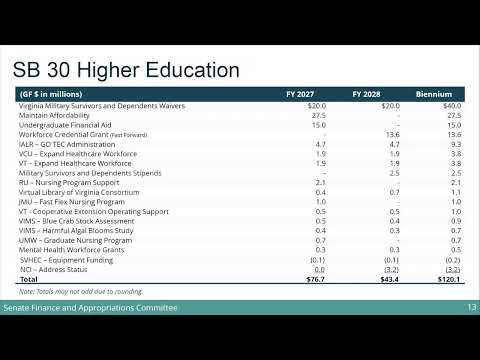
During questioning, senators asked whether 'nonparticipation' savings from the Virginia Preschool Initiative could be reallocated to under‑resourced childcare programs; staff said nonparticipation refers to historically unused slots and that redirected funds would create additional slots without reducing existing filled slots, and staff offered to follow up with precise budget language. On higher education, staff highlighted SB 29 transfers (a $13,600,000 VCCS cash balance transfer for the workforce credential grant program and a $20,000,000 appropriation from 2025 surplus for the Virginia Military Survivors Independent Education Program) and SB 30 higher‑ed actions (a net $120,100,000 general fund increase including $27,500,000 to maintain in‑state affordability, $15,000,000 for undergraduate financial aid, $136,600,000 in the second year for the workforce credential grant program, and a tuition growth cap provision limiting increases to 2.5% or inflation).
Staff also described a second‑year removal of general fund support for the New College Institute (about $3.2 million) and added language directing the board to develop a sustainability and business plan due by August 1. The subcommittee did not take votes on the proposals during the session.
The chair thanked staff and presenters and adjourned; the subcommittee will reconvene on Jan. 22.