Get Full Government Meeting Transcripts, Videos, & Alerts Forever!
Get email alerts on the Land Use topic
No spam. Unsubscribe anytime.
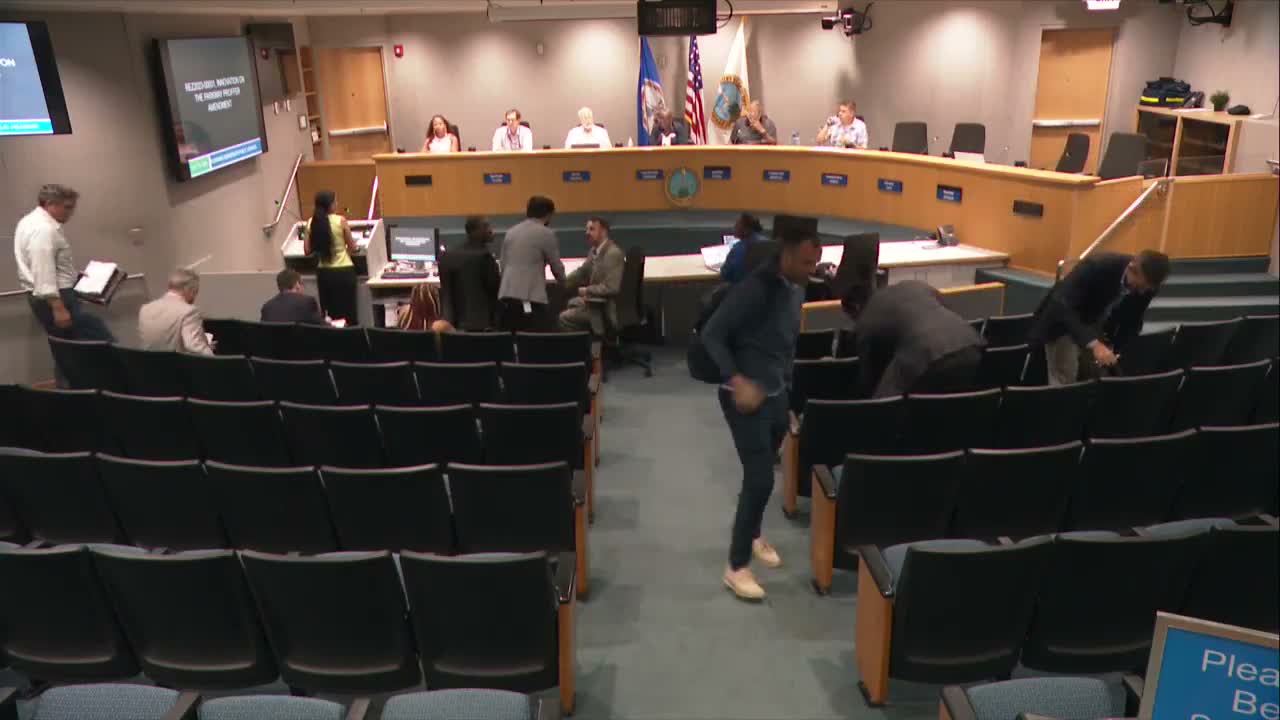
Planning commission recommends approval of Innovation on the Parkway proffer amendment despite community‑design concerns
Summary
The commission recommended approval of a proffer amendment to increase height and FAR for a data‑center redevelopment at the University Boulevard gateway (Innovation), after extended debate about massing, tree‑save impacts, noise and enforceability of sustainability commitments.
The Planning Commission recommended approval to the Board of County Supervisors on July 16 for a proffer amendment that would raise permitted height and floor‑area ratio for a proposed data‑center redevelopment at the University Boulevard gateway in the Innovation area.
Applicant counsel Janelle (Jonelle) Cameron said the proffer amendment would increase building height to an 80‑foot maximum with a 15‑foot cap on rooftop mechanical equipment (about 95 feet inclusive in limited areas) and raise FAR to 0.75 for a 17.68‑acre campus that includes an existing data‑center‑type structure. The team emphasized four‑sided architectural treatments, a recorded 100‑foot tree buffer on Prince William Parkway, 50‑foot buffers on other frontages, additional evergreen plantings, sound‑study proffers, construction‑management and spill‑contingency plans, and a set of sustainability proffers that the applicant is willing to coordinate with the county Office of Sustainability.
Planning staff (Scott Meyer) acknowledged application improvements since an earlier deferral but flagged continuing community‑design weaknesses: the submission remains a concept or “bubble” layout with illustrative plans that were still subject to change, staff was seeking stronger commitments on a fixed master plan layout and additional architectural detail, and tree‑save impacts and sustainability enforcement require more vetting. Staff nevertheless recommended approval, emphasizing the site’s Comprehensive Plan designations (Office‑Mixed‑Use/T‑4 in the Small Area Plan and inclusion in the Data Center Overlay) and the applicant’s proffers to meet multiple design standards.
Resident Rachel Ellis urged denial in virtual public comment, saying the expanded data‑center scale is incompatible with the envisioned mixed‑use University Village and warning of increased power demand and transmission impacts. Commissioners debated the trade‑offs intensively; some said the presented architecture was a significant improvement over conventional data‑center facades, while others said approving a greater height risked an industrial mass that would conflict with the town‑center gateway.
After an initial tie vote on a denial motion, Vice Chair Brown’s subsequent motion to recommend approval passed on roll call. The applicant and staff will continue to work through ARB (Architectural Review Board) review, site‑plan detail, environmental/landscape protections and enforceable proffers ahead of any Board of Supervisors hearing.