Get Full Government Meeting Transcripts, Videos, & Alerts Forever!
Get email alerts on the Hsh Budget topic
No spam. Unsubscribe anytime.
HSH says higher revenue projections reduce deficits, maintain prior OCO investments
Summary
Christine Roland, HSH budget director, told the oversight committee that updated revenue projections add roughly $59 million and allow HSH to maintain prior investments across authorities while reducing previously projected structural shortfalls; she outlined authority-level budgets and said a 10% reserve is built into planning.
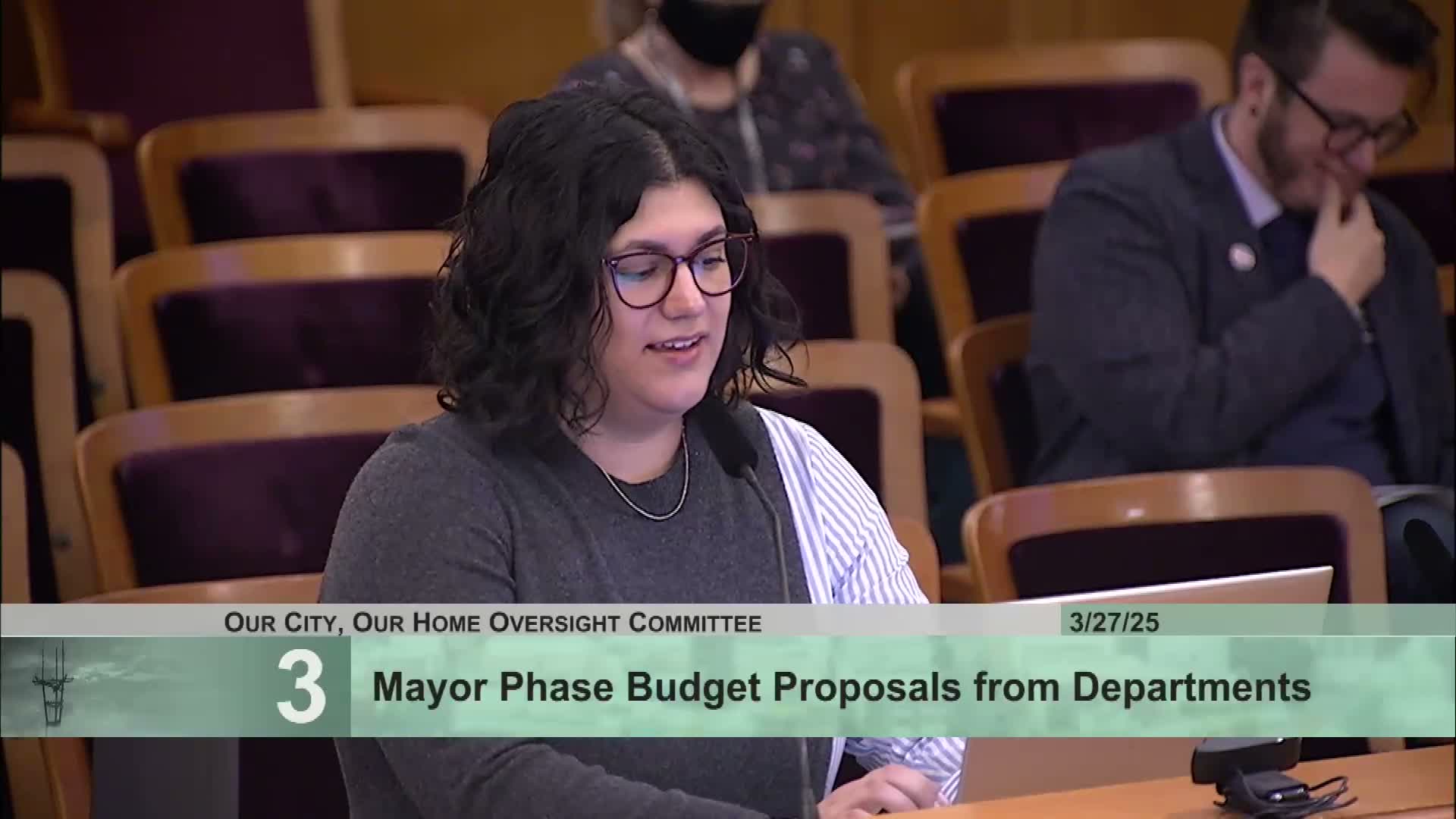
Christine Roland, budget director for the Department of Homelessness and Supportive Housing, presented HSH’s proposed FY25–27 spending plans on March 27 and said recent updates to revenue projections give the department more flexibility going into the mayoral-phase budget process.
Roland said the controller’s office projections tied to Prop M and other factors produced roughly $59,000,000 in higher revenue assumptions for HSH. “Overall, that’s a revenue change for HSH of about $59,000,000,” she said, and added that the department used higher projections and one-time fund balances to avoid deep cuts and sustain investments approved in last year’s budget cycle.
HSH proposed authority-level budgets that largely maintain programmatic investments while including a built-in 10% reserve across authorities. Roland cited example authority figures: General Housing at about $111 million in FY25–26, TAY housing at $38 million in FY25–26, family housing at roughly $40.9 million in FY25–26, and prevention at approximately $69.8 million in FY25–26. Roland told the committee the department has reprogrammed one-time funds to continue prevention and other programmatic investments that otherwise might have fallen off the ongoing spending plan.
Committee members asked how structural deficits differ by service area and whether surplus fund balances in some authorities could be used for ongoing family or youth programming. Member Friedenbach noted year-end surpluses in family and TAY authorities and proposed exploring ongoing flex pools and additional subsidies for families. HSH said differences are driven by programmatic cost structures—shelter operations are largely ongoing costs with little underspend, while prevention and some other accounts previously relied more on one-time balances.
Roland said HSH will continue to bring detailed authority-level information to the committee and work with the steering committee and department liaisons as the budget process proceeds.
Next steps: HSH will provide further detail to committee liaisons and return with materials showing authority-specific assumptions and any recommended reallocation strategies.