Get Full Government Meeting Transcripts, Videos, & Alerts Forever!
Get email alerts on the Behavioral Health Budget topic
No spam. Unsubscribe anytime.
DPH warns of $20M–$25M Ongoing shortfall while stabilizing crisis services
Summary
Kelly Kirkpatrick of DPH told the Our City Our Home Oversight Committee that behavioral health spending plans total about $115 million annually against roughly $90 million in projected revenue, leaving a structural shortfall of about $20–$25 million after one-time funds are used; DPH plans phased capital acquisitions and a crisis stabilization unit opening this spring.
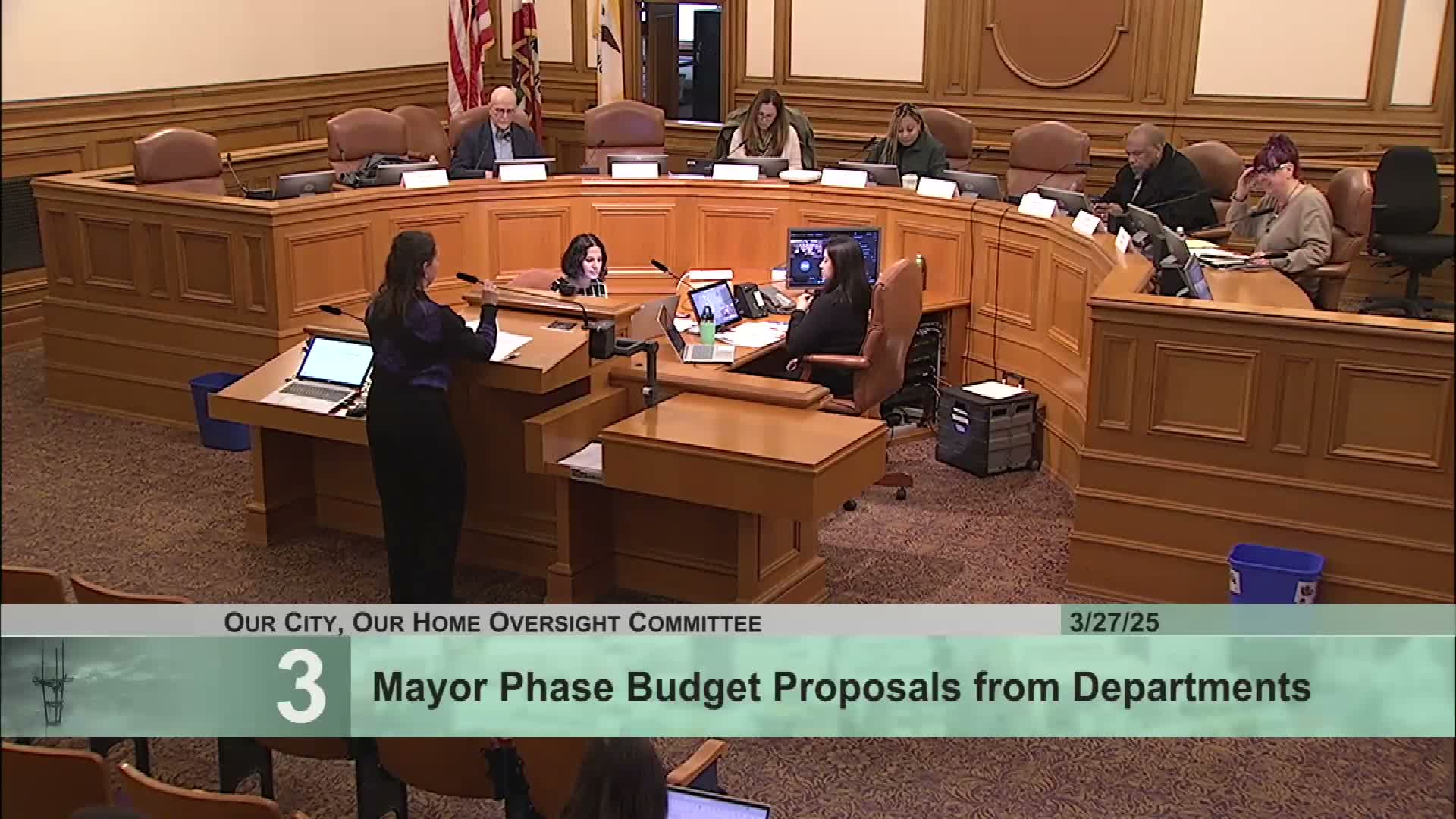
Kelly Kirkpatrick, director of operations and administration for Mental Health SF at the Department of Public Health, told the Our City Our Home Oversight Committee on March 27 that the department’s proposed mayoral-phase budget largely maintains existing OCO programmatic investments but faces a multi-year structural gap. “The structural shortfall is still at about $20,000,000 to $25,000,000 without utilizing one-time funds,” Kirkpatrick said.
DPH is proposing a status-quo spending plan of roughly $115 million a year while projecting about $90 million in ongoing revenue. Kirkpatrick said the department plans to rely on one-time carry-forward reserves to balance the fund through fiscal years 2026–27 but warned of a spending “cliff” in fiscal years 2028–29 if new recurring revenue is not secured.
The department outlined several capital moves and program investments intended to expand capacity. Kirkpatrick described a 16-bed crisis stabilization unit scheduled to open next month as an alternative to emergency department visits, noted purchases of two residential care facilities at 624 and 601 Laguna (general timelines for board consideration in the coming months), and identified long-term construction on Treasure Island for step-down substance-use housing with completion expected in 2028.
Funding plans lean on a mix of local and state dollars: Prop C contributions and leveraged state BCHIP/Bond applications were listed as acquisition funding sources, and Kirkpatrick said the department applied for more than $140 million under Prop 1 bond BCHIP programs with award notices expected in May 2025. “We did apply for over $140,000,000 under Prop 1 bond B CHIP programs this past winter. Awards are expected in May 2025,” she said, while noting that current budgets assume the city does not receive additional state funding.
Committee members pressed DPH on alternative sites after a planned project at 1125 Mission was canceled. Kirkpatrick said the project is not moving forward and that the department has asked state funders whether awarded BCHIP funds can be redirected to an alternative site. She identified space needs for a mental health service center—including a 20,000–30,000 square foot footprint for a behavioral health access center, pharmacy and co-located outreach staff—and said the department is awaiting state guidance on allowable uses of awarded funds.
Kirkpatrick also described implementation steps to close underspending gaps, including contractor ramp-up for permanent supportive housing case management and hiring for program positions. “Hiring and opening the crisis stabilization unit should get us much closer to full spending next fiscal year,” she said.
Next steps: DPH will continue coordinating with the mayor’s office on priorities and return to the committee with additional budget detail and acquisition agreements as plans progress.