Get Full Government Meeting Transcripts, Videos, & Alerts Forever!
Get email alerts on the Land Use topic
No spam. Unsubscribe anytime.
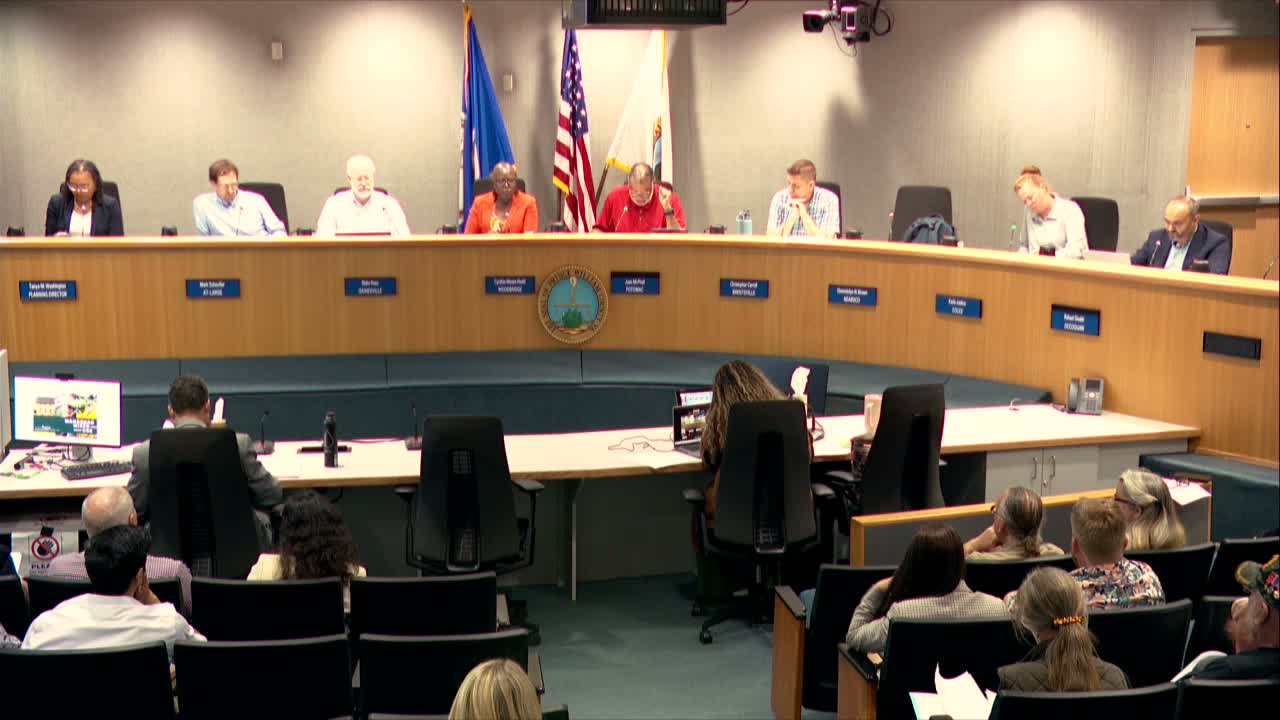
Planning commission recommends Manassas Mall rezoning, narrows parking waiver to transportation staff guidance
Summary
The Prince William County Planning Commission voted to recommend approval of REZ202400039, a phased mixed‑use redevelopment of the Manassas Mall that would add high‑density housing and ground‑floor retail, while directing staff and the applicant to align a residential parking reduction with the county transportation office's 15% guidance.
The Prince William County Planning Commission voted Wednesday to recommend approval of a rezoning that would convert the Manassas Mall site to an urban mixed‑use district and begin a phased redevelopment intended to add hundreds of residential units and ground‑floor retail.
Mike Vanderpool, representing Lionheart Capital, told commissioners the project is intended as a long‑range, 15–20‑year redevelopment that follows the county comprehensive plan's T6 urban transect and aims to replace large parking fields with a mixed‑use, walkable village anchored by new residential buildings and retail promenades. "This case is about the future of Prince William County," Vanderpool said during his presentation, arguing the plan would provide housing diversification and support regional transit over time.
Staff recommended approval. Alex Venegas, the case planner, described the request as a rezoning of roughly 60.56 acres from B‑1 general business to MXD‑Urban (T6) and summarized proffers that would phase construction, provide parking management, and require future return to the commission for subsequent phases. Venegas said staff finds the proposal broadly consistent with the comprehensive plan and Sudley Road redevelopment corridor policies.
Why it matters: Commissioners and members of the public debated several high‑impact tradeoffs — most prominently how much of a parking reduction to allow for residential units in a transit‑oriented redevelopment. Transportation staff recommended a cautious approach (15% reduction for residential parking and a larger reduction for commercial), citing current bus frequencies and ridership constraints. The applicant advocated a larger reduction based on experience with similar projects and the fact the mall contains anchors and many services on‑site.
After more than an hour of questions from commissioners about school capacity, transit connections, interparcel access and affordable housing, Commissioner Carroll moved to recommend approval subject to the applicant proffers dated April 11, 2025. Commissioners agreed to a friendly amendment to align the residential parking reduction waiver with the Department of Transportation recommendation of 15% for residential parking. The motion carried on a roll‑call vote with all commissioners present voting yes.
What remains: The Planning Commission's action is a recommendation to the Board of County Supervisors; the board will make the final decision. The developer and staff indicated they will continue working with county transportation, fire/rescue and adjacent property owners on the parking management plan, interparcel connectivity and other details prior to any Board hearing.
Direct quotes
"This case is about the future of Prince William County," Mike Vanderpool said during his presentation, pitching the project as a catalytic redevelopment that follows the comprehensive plan.
Transportation planning manager Kevin Waraca told commissioners the county supports a parking waiver but urged caution: "We're recommending 15% for residential," he said, noting existing transit service frequency and the difficulty of convincing households to give up car ownership without frequent, all‑day transit.
Next steps
The commission's recommendation and the applicant proffers will be forwarded to the Board of County Supervisors for a final decision. Staff, the applicant and transportation will continue refining the parking management plan and other mitigation measures ahead of that hearing.