Get Full Government Meeting Transcripts, Videos, & Alerts Forever!
Get email alerts on the School Planning topic
No spam. Unsubscribe anytime.
Prince William County Schools unveil redesigned enrollment model and public planning portal
Summary
Prince William County Schools described a redesigned cohort‑survival enrollment model, a public planning portal and a residential impact‑statement dashboard designed to improve redistricting, CIP planning and project reviews. Officials said the model projects a roughly 3,700‑student decline over five years.
Prince William County Schools told the Planning Commission on July 16 that it has rebuilt its enrollment forecasting model and launched public online tools to make impact statements and mapping data more accessible.
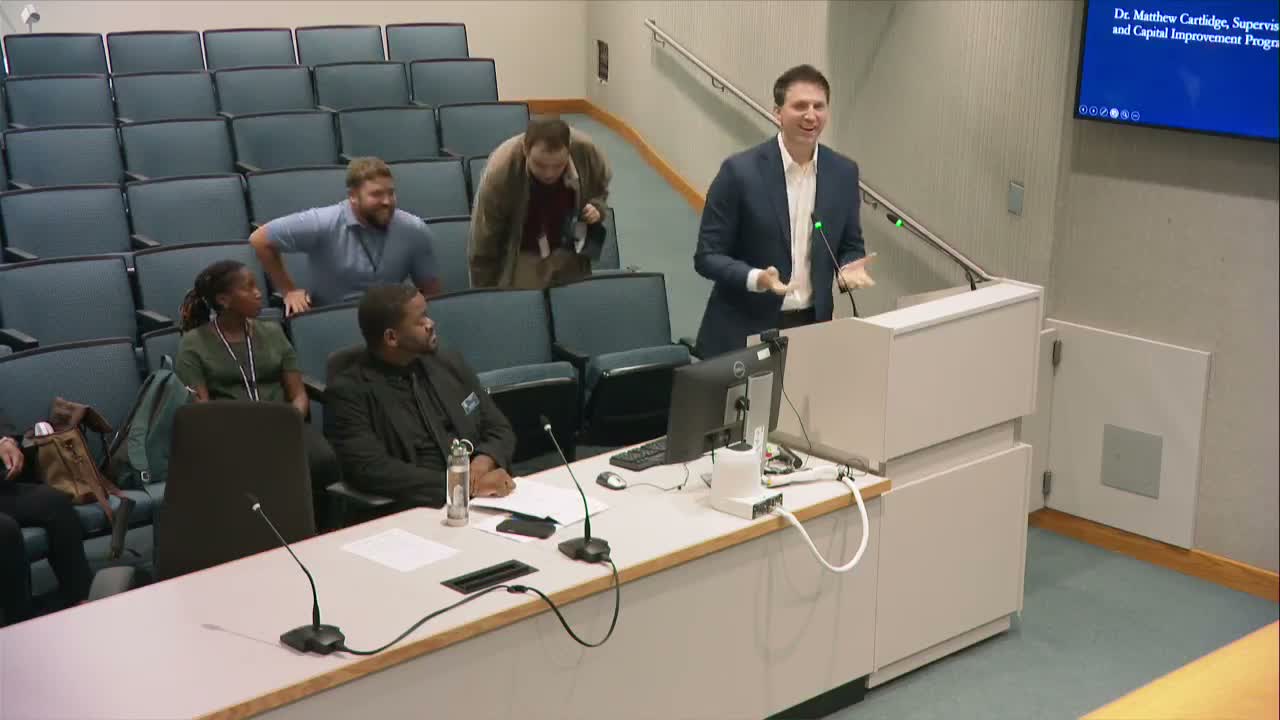
Dr. Cartlidge, who leads the division’s planning staff, said the updated model is built on the cohort‑survival method and augmented with neighborhood‑level build‑out scenarios and birth‑record correlations. "The projection model is suggesting that we're going to experience about a 3,700 student decrease over the next 5 years," he said, arguing the redesign reduced recent budget forecasting error from roughly $30 million to about $12 million.
The division’s GIS programmer, Christopher Papp, previewed a planning portal that publishes enrollment and non‑enrollment reports, accessible PDFs and interactive web maps showing attendance areas, facilities and tracked development projects. Planning staff emphasized the dashboard is intended to increase transparency for school‑district impact statements prepared since April 2024 and to give county staff earlier access to yield estimates during application review.
Atanya Allen described procedural changes to the division’s residential development impact statements (Regulation 8013), which now use student yield rates calculated from houses 10 years old or newer. Allen said impact statements now explicitly list current assigned schools, capacity utilization for a five‑year horizon and the anticipated student yields for a proposed development; the statements also show estimated capital impacts per pupil, which the division will use to estimate project capital costs.
Facility planning staff detailed related initiatives: a 2–3 year LiDAR scanning and BIM effort to update floor plans and life‑safety maps, a new CMMS integration for facilities data and planned program‑capacity metrics for high schools to inform the FY27–31 CIP. Staff said program capacities exclude portable classrooms because they are not permanent solutions and noted program capacity will account for smaller class sizes required by certain grant‑funded programs.
Why it matters: the new model and public portal are intended to give county planners and the public more precise, project‑level estimates of how new housing will yield students, and to speed up review of development applications that trigger school impacts. The school division and planning staff agreed to accept written questions from the commission and to return for a follow‑up work session to walk through the model outputs in more depth.
What’s next: commissioners set August 29 as the deadline to submit questions to the clerk; staff and school planners plan a follow‑up meeting in September.