Get Full Government Meeting Transcripts, Videos, & Alerts Forever!
Get email alerts on the Land Use Housing topic
No spam. Unsubscribe anytime.
Planning commission defers Moreland Meadows rezoning after neighbors cite stormwater, traffic and school impacts
Summary
The Planning Commission deferred the Moreland Meadows rezoning to Oct. 29 to allow the applicant and county staff to finalize an alternative stormwater plan and complete inter-agency reviews after multiple neighbors raised concerns about runoff, traffic and school capacity.
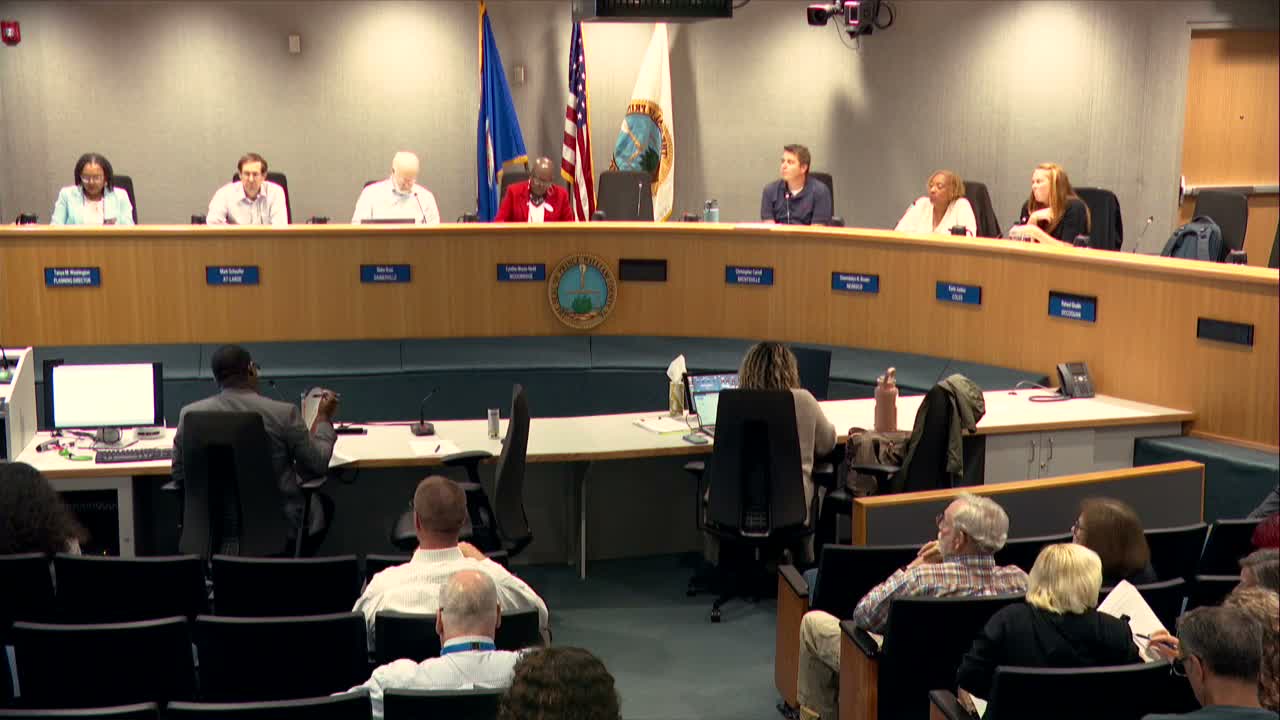
The Prince William County Planning Commission voted to defer action on the Moreland Meadows rezoning application (REZ2024-00028) to a date-certain of Oct. 29, 2025, after public comment and extended commissioner questioning about stormwater, traffic and community impacts.
Applicant representatives proposed rezoning roughly 15.35 acres from A-1 Agricultural to Planned Mixed Residential (PMR) to build 63 residential units (about 15 single-family detached homes, 23 estate townhomes, 18 townhouses and a proffer of seven affordable dwelling units). Clark Massey, agent for the applicant, said the development would provide 50% open space (above the 30% PMR minimum), build a right-turn lane on Linton Hall Road, and expand an existing farm pond substantially as a stormwater-management measure if allowed by the Virginia Department of Environmental Quality (DEQ).
Several nearby residents spoke in opposition during the public hearing, raising three recurring concerns: stormwater runoff and the existing farm pond's capacity during heavy rain events; additional traffic on an already-congested Linton Hall Road corridor and the safety record at nearby intersections; and strain on local schools and community services. "If this stormwater is not managed really well, we're gonna have flooding on the lower sections of the existing houses," said neighbor Alan Curley. Vera Baguna and other residents questioned whether seven affordable units (about 10% of the project) meaningfully addressed local housing affordability.
Staff and applicant representatives responded with technical details and commitments. The applicant said alternative engineering plans were prepared after DEQ signaled the existing pond inside the RPA would not qualify as a regional pond; the alternative shifts the stormwater facility outside the RPA and preserves more peripheral open space. Applicant and staff said the project's estimated trip generation is roughly 650 trips per day and that the county has calculated peak-hour trip figures (about 34 trips per peak hour); the developer has proffered to construct a right-turn lane for southbound traffic to improve ingress.
County environmental staff explained they had reviewed the applicant's earlier plan and consulted DEQ; DEQ did not support a regional pond inside the RPA, prompting the alternative plan. Staff said either option would still have to meet county stormwater/DCSM and DEQ requirements and that post-development peak runoff must not exceed pre-development rates. Transportation and public-safety staff acknowledged accident history along portions of Linton Hall Road and said they are evaluating mitigation options.
Commissioners expressed varying views: several thanked residents for their comments and pushed for clearer exhibits and more detailed technical materials. Commissioner Carroll, who said he recognized the PFR consistency with existing facilities but remained concerned about the SUP fit with rural character, moved to defer to Oct. 29 to allow the applicant to revise exhibits and for staff to complete inter-agency reviews. The motion passed on roll call.
Staff said the Oct. 29 date is subject to state notice requirements; because Virginia law requires properly noticed hearings, the application will be re-noticed and the public will have an opportunity to comment at the October hearing. The applicant agreed to meet again with neighbors and said the alternate plan would be refined and circulated for staff review prior to the board hearing.
Key open issues left for the record include detailed stormwater modeling tied to the chosen pond location, final buffer and tree-preservation plans along the downriver property line, and final transportation agency review of the right-turn lane and collision mitigation at nearby intersections. The commission instructed staff to complete inter-agency review before forwarding recommendations to the Board of Supervisors.