Get Full Government Meeting Transcripts, Videos, & Alerts Forever!
Get email alerts on the Urban Forestry topic
No spam. Unsubscribe anytime.
Urban Forestry reports net tree gains, backlog shrinking but funding uncertainty remains
Summary
The Bureau of Urban Forestry reported meeting pruning targets, reducing removals and increasing plantings (projected 1,300 trees this year), but noted contractor and funding constraints and a switch to a new CMMS data system that affected reporting.
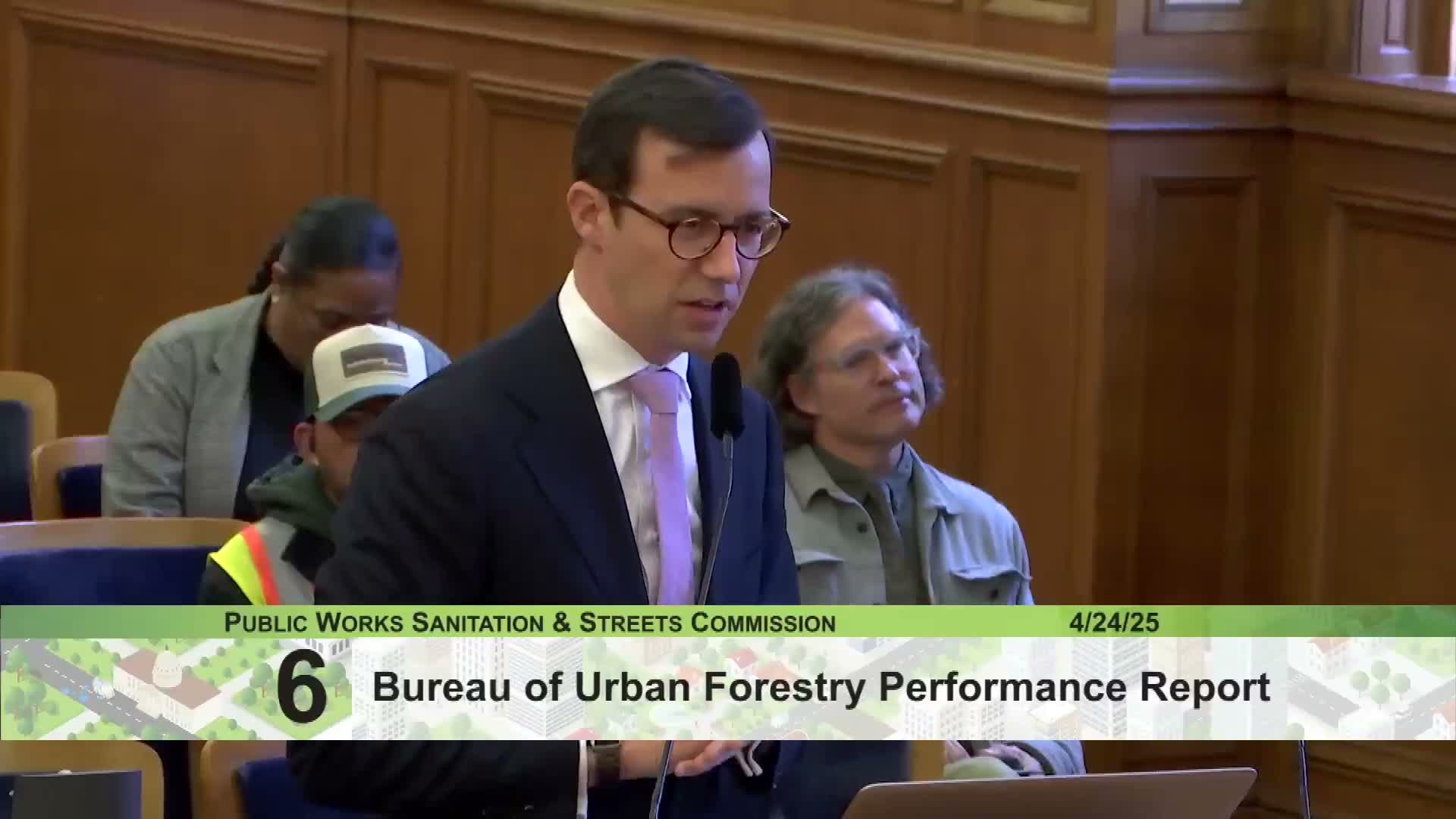
The Bureau of Urban Forestry told the Sanitation and Streets Commission on April 24 that the city is now planting more street trees than it is removing and that program metrics are improving, though staffing and funding constraints could affect momentum.
Nicholas Crawford, assistant superintendent, said the Street Tree SF maintenance program has pruned about 77% of assigned street trees since the program began and that the bureau's internal crews are projected to prune about 5,900 trees this year, with a target projection of 7,409 trees if contractor support is added. Crawford said total street tree assets number roughly 125,000.
Crawford told the commission that removals peaked in fiscal 2023 (about 1,466 trees) but have dropped to roughly half that recent level. The bureau projects planting between 1,000 and 1,800 trees this year and estimated its FY projection at about 1,300, a shift Crawford said represents crossing the line from net losses to net gains in street tree counts.
Staff described operational challenges: a recent migration to a CMMS asset management system (cutover Dec. 8) temporarily reduced inspection reporting consistency; contractor procurement and a shortage of cement masons limit the bureau's ability to perform sidewalk repairs tied to tree work; stump grinding is being scheduled in batches because of underground‑utility checks and mobilization constraints; and targeted grant funding supports about 250 additional planting permits annually focused on low‑canopy neighborhoods such as the Bayview.
Commissioners asked about storm losses (Crawford said fewer than 40 trees were lost this winter) and timelines for stump grinding and replacement plantings, which Crawford said depend on whether removals were emergency responses or scheduled removals and on grant eligibility. Staff also explained that canopy percentage (13.7% citywide) is a different metric from street tree counts and will move slowly because newly planted trees take years to develop large canopy.
The commission received the informational report and had no public commenters on the item.