Get Full Government Meeting Transcripts, Videos, & Alerts Forever!
Get email alerts on the Refuse Rates topic
No spam. Unsubscribe anytime.
Controller's office proposes smaller refuse rate increase than Recology, pauses $35M trash‑processing contingency
Summary
The controller's refuse rates administrator presented a three‑year rate order that trims Recology's requested increases and excludes a $35 million trash‑processing contingency pending further study; the office projects tens of millions in savings to ratepayers versus Recology's application.
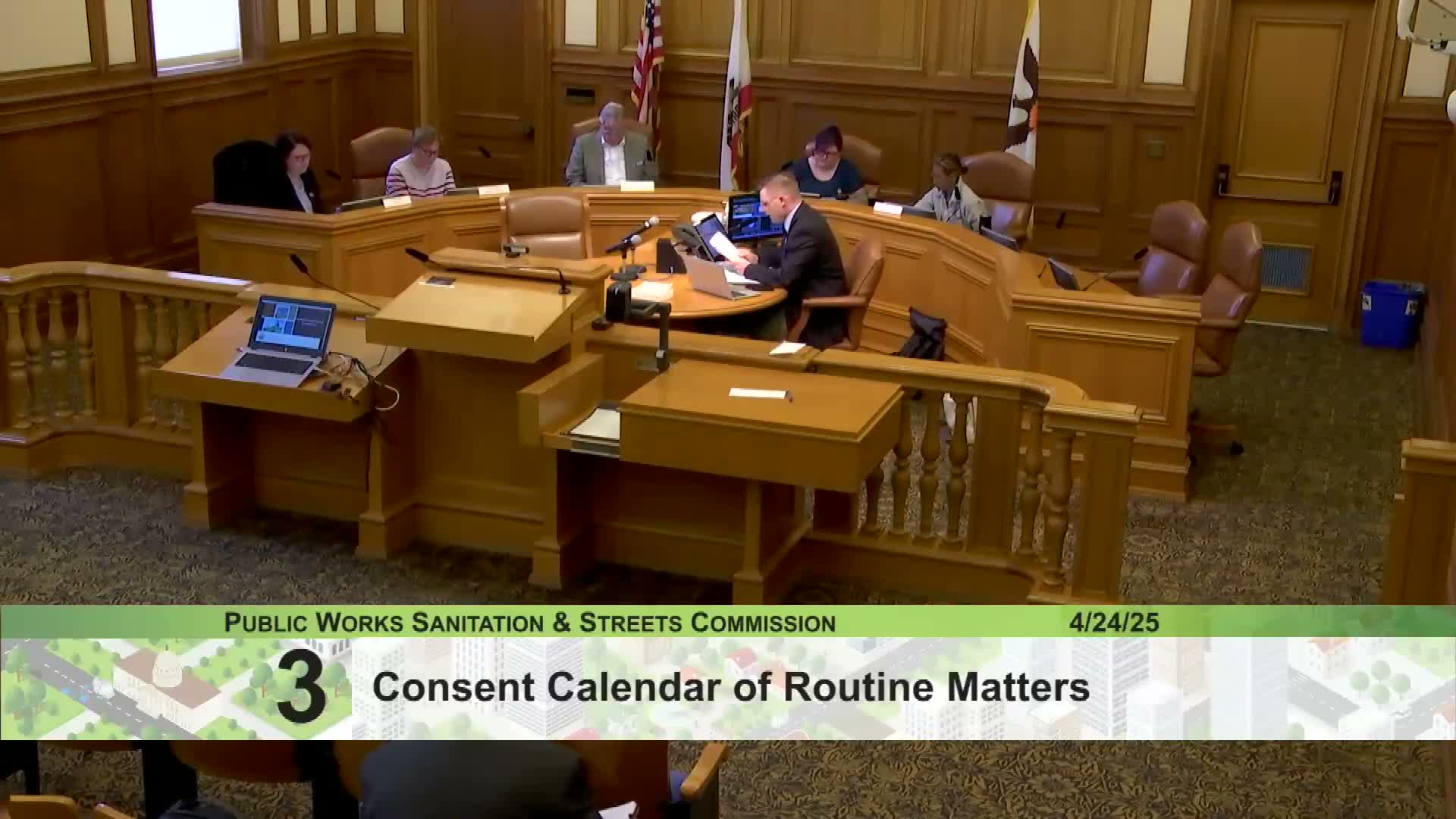
The Sanitation and Streets Commission on April 24 heard a public hearing from the controller's refuse rates administrator on a proposed three‑year refuse rate order for rate years 2026–2028. Jay Liao of the controller's office said the proposal reduces Recology's requested 18.18% increase to a 12.59% package the controller's office is recommending, which the presentation characterized as roughly a 5% cumulative savings compared with Recology's application and a monthly savings of about $2–$2.63 for a single‑family default service customer in the first year.
Liao told commissioners the controller's office is implementing the mandate of 2021's Proposition F, which moved refuse‑rate administration to the controller and established four guiding principles for rate setting: cost‑effective service meeting standards and environmental goals, rate stability and fairness, transparent and publicly accessible processes, and high professional ethical standards. He outlined the timetable for the rate process: the controller's rate report and proposed rate order expected May 9, rate board hearings beginning May 27, and an anticipated effective date of Oct. 1 if finalized.
The presentation cited a previously discovered material accounting mistake (about $23,000,000) that produced a rebate and a one‑time negative rate adjustment in an earlier rate year; Liao said the controller's office conducts third‑party reconciliations, audits, and formal information requests to validate rate applications. Liao described expense adjustments and other negotiations he said reduce Recology's originally proposed costs, yielding an estimated $50,000,000 in savings for ratepayers relative to Recology's submitted filing, with $37,000,000 attributed to expense adjustments.
A contentious point in the presentation was Recology's contingent schedule to fund a proposed trash processing facility (estimated at $35,000,000). Liao said the controller's proposed rate order does not include that contingency because "the risks were too high for this level of investment with the level of information we have" and instead funds about $400,000 to study whether a facility is viable before asking ratepayers to shoulder construction costs. He said the environment department requested trash processing but that the controller's office removed the construction contingency from its recommendation.
Liao also described regulatory improvements the controller's office plans to use going forward: service level agreements documenting Recology's obligations, cost‑control processes including variance reviews and hard cost caps, baseline operating metrics, and a balancing account designed to keep Recology's profit close to the allowable 9% margin by adjusting rates for verified cost variances.
During questioning, commissioners asked whether Recology was profitable and whether the payroll and accounting errors cited affected ratepayer costs. Liao said Recology is profitable but has not been achieving the allowable 9% margin due to lower tonnage, and that a payroll reporting omission in prior filings underestimated payroll costs and therefore reduced prior rate projections (benefiting ratepayers until corrected). He described oversight as shared across the controller's office, Public Works, and the Environment Department, and said the refuse rate board (which includes the city administrator, the PUC general manager, and a ratepayer representative) will hold hearings and make the final decision.
Secretary Fuller opened opportunity for public comment on the rate hearing; no members of the public spoke in person or over webinar. The controller's office will include commission comments in the May rate report and present the proposed order to the rate board at hearings scheduled later in May.