
Senate Finance hears case for $45M to shore up homelessness services and $135M housing trust fund request
Get AI-powered insights, summaries, and transcripts
Subscribe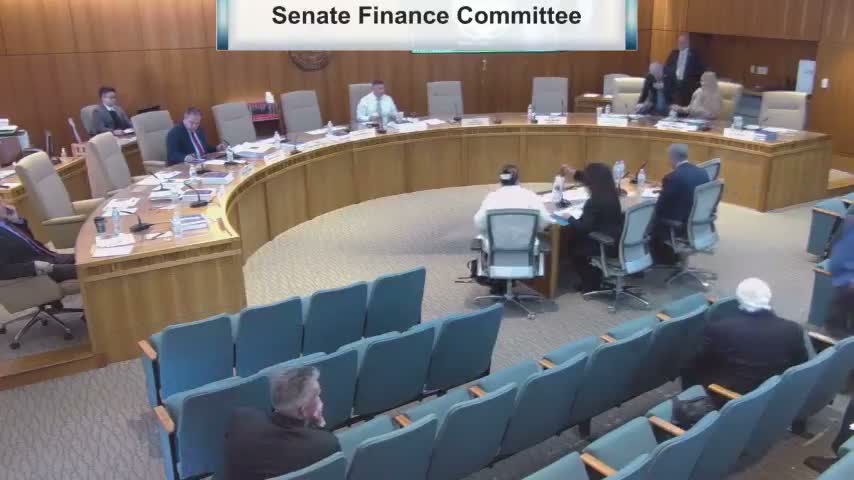
Summary
State officials told the Senate Finance Committee that federal uncertainty and proposed HUD rule changes put tens of millions in housing supports at risk and urged state dollars to preserve continuity; presenters also outlined long-term housing trust fund and mortgage-assistance options.
Sarita Nair, secretary of workforce solutions, told the Senate Finance Committee that New Mexico has deployed roughly $128 million so far for affordable and attainable housing and related programs and that about 66% of those funds supported housing production. Nair said the department has used intergovernmental agreements, data metrics and evaluation partnerships to speed delivery and learn what works.
Nair warned that earlier 2025 federal proposals from the U.S. Department of Housing and Urban Development (HUD) would have “drastically changed” homelessness funding and, in aggregate, threatened roughly $16.7 million in rent payments that now help keep 7,696 households housed. “That kind of uncertainty,” Nair said, “is why we asked for $45 million in the governor's budget — because anytime continuity breaks, we talk about people physically on the street.” She said New Mexico joined other states in challenging the HUD requirements and an injunction temporarily halted the rule changes.
Housing New Mexico's representative (identified in testimony as Izzy) outlined broader housing needs and the agency's production metrics: housing units rose about 3.5% from 2020 to 2024 while population grew approximately 0.6%; home prices increased roughly 72% between 2018 and 2023 while incomes rose about 22%. The presenter said the agency assisted nearly 18,000 households this year, has a pipeline of more than 500 single‑family units, and reported $166 million placed into the Housing Trust Fund over the last 2½ years (100% encumbered, 85% awarded, 45% spent).
On mortgage assistance, Housing New Mexico presented two program models. One is a proposed 3% fixed-mortgage program the agency estimates would require about $200 million and produce just over 700 loans, lowering qualifying families' payments by about $600 per month on a $300,000 example. The other was an interest-rate buy-down scenario: a 1% reduction in rate could lower a sample $300,000 mortgage payment by roughly $200 per month and, at an estimated $30 million cost over three years, reach about 2,100 loans. The presenter said both approaches have trade-offs and a place in policy depending on available funding.
Committee members pressed for detail on geographic distribution and timing. Lawmakers asked for underwriting standards, typical timelines from award to market, and whether awards duplicated other programs such as local housing authority initiatives. Presenters said the RFP process included points to expand geographic diversity and that some line items were intentionally reimbursement-based, which affects when funds appear in project cashflows.
What happens next: committee members asked agencies to return with clearer timelines for money to reach projects, an explanation of overlapping programs and a consolidated guide to the array of assistance buckets. The presentations served as the basis for budget deliberations; the committee recessed and requested follow-up materials on program deployment, underwriting and the potential $45 million expansion for homelessness continuity.