Get Full Government Meeting Transcripts, Videos, & Alerts Forever!
Get email alerts on the Annexation topic
No spam. Unsubscribe anytime.
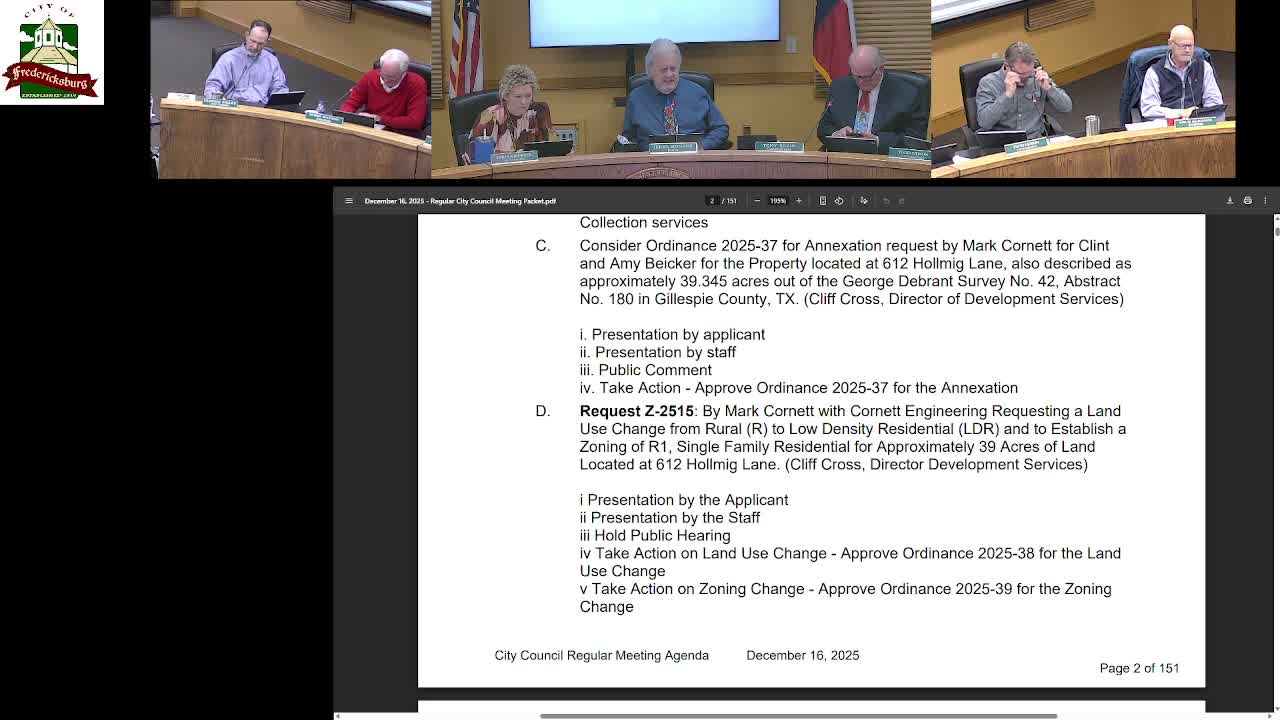
Fredericksburg council denies Sonoma Oaks annexation after neighbors cite drainage and safety risks
Summary
After hours of public comment about downstream flooding, erosion and contaminated runoff, Fredericksburg City Council voted unanimously to deny ordinance 2025-37, an annexation request for a parcel at 612 Holme tied to the Sonoma Oaks development and directed city engineers to keep working with the county on drainage solutions.
Fredericksburg City Council on Jan. 6 voted to deny ordinance 2025-37, an annexation request for a parcel at 612 Holme associated with the Sonoma Oaks development, after extensive public testimony raising drainage, erosion and public‑safety concerns.
Neighbors and property owners urged the council to delay any annexation until short‑ and long‑term drainage solutions are identified and implemented. Gina Enderlin, who participated in facilitated meetings between homeowners and the developer, said the dialogue clarified problems but did not produce a workable fix and warned, "just because we can does not mean we should." Kyle Segnor told council that combined flows from phase 1 and a proposed phase 2 would add "millions of gallons" of runoff to downstream properties and that residents should not bear that burden alone.
Developer representatives and staff said required public hearings had been held and that facilitated meetings revealed both areas of agreement and persistent disagreement. Corey, speaking for the applicant, said the facilitated sessions helped clarify concerns but did not resolve fundamental differences between the parties.
City staff and the city manager outlined technical and jurisdictional limits: the city enforces design standards only for property inside city limits, while the county controls lands outside the city. County and city officials described a countywide drainage study that could take several years and potentially identify grant opportunities for large regional projects, but they cautioned those efforts would not be a near‑term fix.
After discussion, a motion to deny the annexation passed on a roll call with unanimous support. Council also directed city engineers to continue working on technical options and to coordinate with county staff to seek potential short‑ and long‑term solutions.
The decision leaves the property outside the city limits for now. Council members and residents said the denial reflects concern that existing site designs and downstream channels do not adequately address increased volume and changed flow patterns from recent development.
What happens next: City engineers will continue work with county partners and the applicant to explore mitigation options. Council members indicated they would revisit the issue if staff or the county return with concrete engineering or funding proposals.