Senate subcommittee reviews general‑government portions of 2026 biennial budget and caboose bill
Loading...
Summary
Staff briefed a Senate subcommittee in Richmond on SB 30 (biennial budget) and SB 29 (caboose bill), outlining a proposed $124.7 million one‑time bonus for state employees, health‑plan cost increases, VRS/OPEB savings, and language allowing use of up to $1.1 billion of surplus to supplant bond financing.
Staff for the Senate presented the general‑government sections of the 2026 biennial budget (SB 30) and the companion "caboose" bill (SB 29) to a subcommittee meeting in Richmond, highlighting personnel, health‑plan, and central‑appropriation changes that will be examined in fuller detail at a subsequent full‑committee hearing.
"This is just the opportunity to ask more detailed questions because we kinda go through this a little bit faster tomorrow to get through the entire budget," the session presenter (Speaker 5) said as the committee opened the briefing and framed the hearing as a preview of items that will return to the full committee.
Why it matters: the package includes a mix of one‑time and ongoing costs that affect state agencies, employees and localities. Speaker 5 said the caboose bill proposes a required deposit to the revenue reserve fund and a $124,700,000 general‑fund, one‑time bonus — described as equivalent to about 2% of salary for state employees and state‑supported local employees — that would be paid in June 2026 if the measure is adopted.
Key allocations and adjustments: Staff said the general‑government portion of the biennial budget carries roughly $723 million in general‑fund allocations across covered areas. The largest single item cited was $402,900,000 proposed to cover a 2% salary increase in both years of the biennium (first year visible in August paychecks; second year effective July 1). The budget also contains about $243,500,000 to fund the employer share of state employee health insurance premiums after actuary‑projected cost pressure; staff noted introduced proposals that would reduce the health‑plan increase from a roughly 19% actuarial estimate to an about 13% increase via multiple cost‑containment measures.
Pensions and retiree benefits: The presenters identified two main savings proposals: about $95.5 million tied to lower Virginia Retirement System (VRS) contribution rates and about $49.7 million linked to other post‑employment benefit (OPEB) adjustments. Speaker 5 said Trish Bishop will provide more detailed VRS analysis at a later meeting.
Judicial and public‑safety items: The judicial presentation (Speaker 6) flagged rising criminal fund payments driven largely by court‑appointed counsel costs, increased interpreter expenses, expanded courtroom video‑conferencing and a judicial security operations center focused on cybersecurity. The compensation board request includes $4.6 million annually, primarily to fund 71 deputy positions to maintain local minimum staffing levels, the presenters said.
Agencies, IT and operations: Staff noted Department of Elections funding of $3.3 million to replace the campaign‑finance system (separate from the Verus matter) and Department of General Services concerns about a statewide rent rate held at $15.50 per square foot in the introduced budget that may be insufficient in the second year. The budget also provides roughly $13.3 million (non‑general fund) for VIDA internal service fund adjustments and additional funding for a substance‑use disorder data analytics platform supported by opioid‑settlement funds.
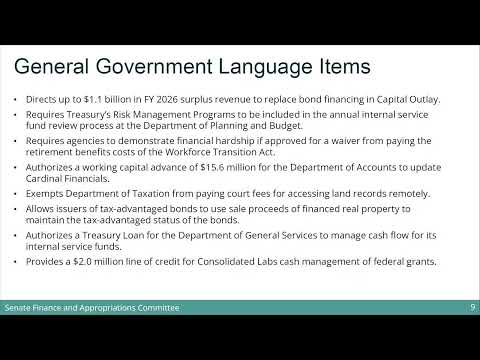
Language and policy provisions: The presenters described language that would allow up to $1.1 billion of any FY26 surplus to supplant bond financing for capital outlay, reserving the funds on the comptroller's balance sheet for the next fiscal year; a provision to include treasury risk‑management programs in an annual internal service fund review; a Workforce Transition Act waiver change requiring demonstration of financial hardship for certain agency exemptions; a $15.6 million working‑capital advance for the Department of Accounts to update Cardinal Financials; and an exemption allowing the Department of Taxation remote access to land records without paying court fees to reduce travel costs.
Questions and followup: Committee members pressed for clarifications about how surplus and rainy‑day deposits operate (Speaker 2 asked, "So the the required rain day deposit, that is what percent of that of the leftover funds is there?"), and staff offered to follow up with more precise calculations. Staff also said additional agency briefings are scheduled — Department of Elections, Virginia Retirement System and judicial representatives next week, and Department of Human Resource Management thereafter — and that no formal committee votes were taken during the briefing.
What comes next: Staff will present a more detailed, department‑by‑department budget briefing to the full committee; the subcommittee will follow up on VRS actuarial details and DGS building‑management/rent‑rate options. The presentation concluded with the committee scheduling further department appearances and no formal action recorded at this session.