
Virginia Senate declines floor amendments to reproductive-freedom constitutional amendment
Get AI-powered insights, summaries, and transcripts
Subscribe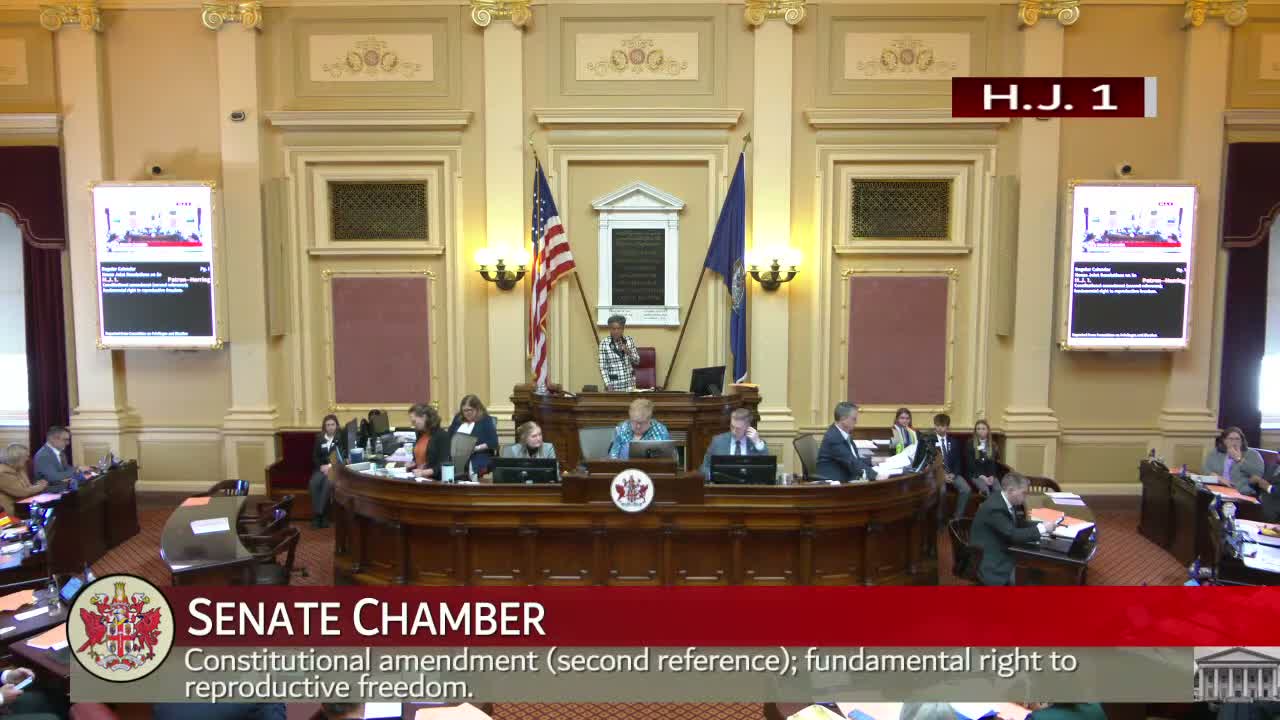
Summary
On Jan. 15, 2026, the Virginia Senate debated two floor amendments to a proposed constitutional amendment on reproductive freedom and rejected both — one to preserve parental-consent laws and another clarifying care for newborns born alive. The joint resolution was engrossed and advanced to a third reading.
Richmond — The Virginia Senate spent the morning of Jan. 15 debating floor amendments to a joint resolution that would place a constitutional amendment on reproductive freedom before voters.
Sen. Jennifer Durant (Stafford) offered a floor amendment she said was aimed at preserving existing parental involvement laws. "Parental involvement is it really truly is about protecting minors," Durant said, urging colleagues to "respect that and that we pass this amendment." Opponents argued the change was unnecessary and could alter the legal standard for parental-consent laws.
Sen. Boisco (Northern Fairfax) disputed factual assertions cited in support of Durant's amendment, saying an investigation in Fairfax County "showed that there were no accusations that were based in fact." Sen. Obenshein (Rockingham) warned that transforming the measure into a constitutional "fundamental" right would change judicial review: "If this passes, mark my words. Those, reasonable restrictions ... will be struck down by the courts," he said, arguing the amendment could render parental-consent statutes vulnerable under strict scrutiny.
After debate the Durant floor amendment was put to a recorded vote and failed, 19-20.
Shortly afterward Sen. Carter Jordan (Isle of Wight) offered a separate, narrower amendment aimed at clarifying that a newborn born alive should receive medical care. "When a child is born alive, they will be provided medical care just as if every other person sitting in this chamber would be entitled to," Jordan said. Sen. Boyce called the amendment a "fear tactic," arguing current medical standards and law guide care in the rare cases of late-term pregnancy complications and that the amendment risked politicizing complex medical judgment.
The Jordan amendment also failed on a recorded vote, 19-20.
Despite those defeats, the Senate voted to engross and advance the joint resolution proposing the constitutional amendment on reproductive freedom to its third reading.
What happened next: The joint resolution will return for further consideration at a later stage in the session; the requirement to pass constitutional amendments in identical form in two sessions with an intervening election remains the governing process.
Why it matters: The debate centered on whether narrowly worded floor amendments would preserve parental-consent statutes and clarify medical duties without changing the substance of the proposed constitutional right. Senators on both sides framed the issue as balancing parental roles, medical ethics and the legal consequences of embedding rights in the state constitution.
The Senate did not adopt the Durant or Jordan floor amendments. The full joint resolution on reproductive freedom was engrossed and advanced to its third reading.