
Subcommittee OKs linking pretrial data to Virginia Longitudinal Data System with privacy safeguards
Get AI-powered insights, summaries, and transcripts
Subscribe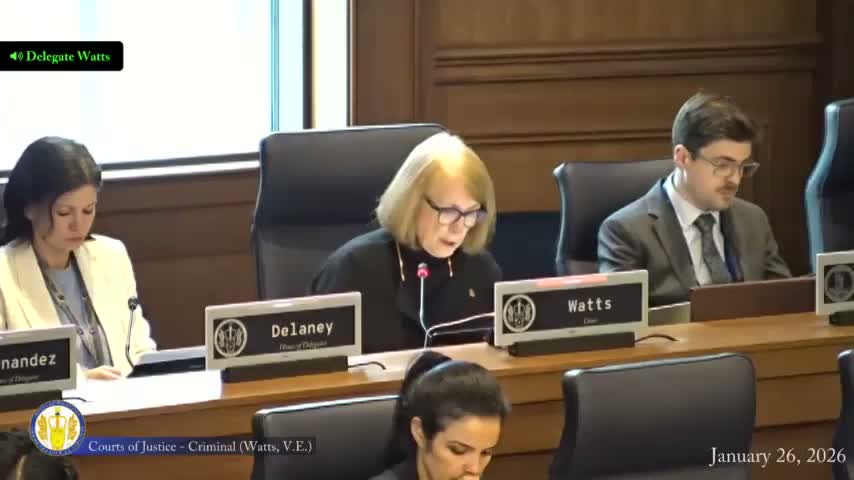
Summary
The subcommittee unanimously reported HB1084, authorizing the Sentencing Commission to share pretrial records with the Virginia Longitudinal Data System (VLDS) for approved research after strengthening language to limit personal and case‑identifying information to linking uses and exempt such data from FOIA.
The Criminal Law Subcommittee voted 9–0 to report HB1084 after adopting an amendment tightening privacy language for sharing pretrial data with the Virginia Longitudinal Data System (VLDS).
Delegate Delia Hernandez, the bill’s patron, told the committee the measure would allow the Virginia Criminal Sentencing Commission’s pretrial dataset to be linked to education, workforce and other outcome data so policymakers can assess the real‑world effects of pretrial decisions. "Better data leads to better policy," Hernandez said.
Experts and stakeholders described the VLDS access model: individual researchers and analysts are vetted, identifiers remain protected within the VLDS, and researchers receive linked but de‑identified datasets for approved projects. Economist Ariel Nishant (identified in the transcript) and Maisie Osteen (Legal Aid Justice Center) explained that researchers apply for specific projects, sign agreements, and cannot access personally identifiable information; VLDS retains linkage keys and provides re‑anonymized data for analysis.
Committee counsel offered two wording options; the subcommittee selected language that requires any personal or case‑identifying information to be used only for linking datasets to create de‑identified datasets and specifies that such data are not subject to the Virginia Freedom of Information Act. Proponents on record included the ACLU of Virginia, the Commonwealth Institute, Justice Forward Virginia, the Humanization Project and Legal Aid representatives.
The amendment was adopted and the bill was reported unanimously 9–0. The transcript does not record fiscal impacts or an implementation timeline beyond the standard VLDS vetting process discussed in testimony.