
Panel advances bill to codify Chesapeake Bay Outcomes Fund and reward results
Get AI-powered insights, summaries, and transcripts
Subscribe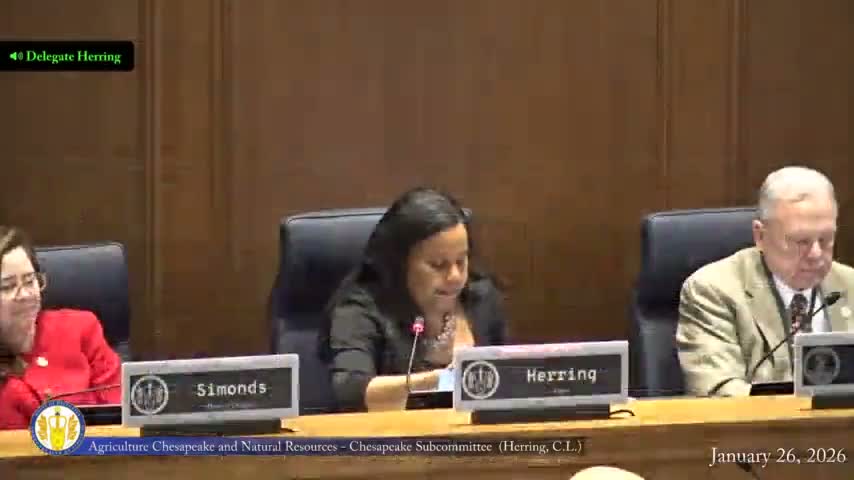
Summary
The subcommittee voted to report HB 386, which would codify an outcomes-based Chesapeake Bay fund, rank projects by verified pollution reductions and provide $20 million for the next funding round; proponents said the pay-for-outcomes pilot encouraged innovation and measured results.
Delegate Krezyk introduced HB 386 to make the Chesapeake Bay Outcomes Fund a permanent, outcomes-based mechanism for funding projects that demonstrably reduce nutrient and sediment pollution. The sponsor said the pilot generated strong interest — more than $110 million in requests — and proposed a $20 million allocation for the next round.
Supporters including Joe Wood, a scientist with the Chesapeake Bay Foundation, told the committee that traditional best-management practices often prescribe actions rather than measure verified environmental results. "An outcomes-based approach is going to encourage innovation," Wood said, adding that pilot projects have demonstrated measurable reductions such as capturing nitrogen from poultry houses and adjusting dairy feed to reduce nutrient losses.
Multiple conservation groups and regional stakeholders spoke in favor. Testimony emphasized that ranking projects by effectiveness — rather than simply displacing pollution — would ensure state dollars buy the greatest pollution-reduction per dollar spent.
The subcommittee voted to report HB 386 and refer it to Appropriations (vote recorded as 10–0). The bill would require interagency coordination (DEQ with DCR and Virginia Tech) to rank projects and direct fund awards to high-performing proposals; appropriations will determine the final funding and structure.