Get Full Government Meeting Transcripts, Videos, & Alerts Forever!
Get email alerts on the Drinking Water topic
No spam. Unsubscribe anytime.
Subcommittee backs program to test and help treat private wells for PFAS
Summary
The subcommittee voted to report HB 348 (10–0), a bill to create a residential well testing and treatment program targeted at households with economic need, after hearing multiple personal testimonies about PFAS in private wells and support from conservation groups and public-health advocates.
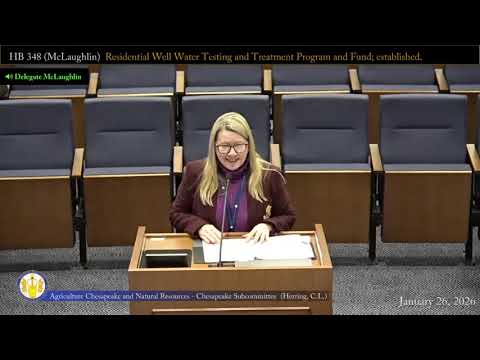
Delegate McLaughlin told the subcommittee HB 348 would establish a residential well water testing and treatment program and a program fund to help homeowners with economic need install point-of-use and point-of-entry filtration systems once contaminants are identified.
Witnesses described PFAS contamination in private wells and urged action. Jay Ford of the Chesapeake Bay Foundation said PFAS is a known health hazard in rural Virginia and that private wells lack the same oversight as municipal systems. "PFAS contamination is...a well known health hazard at this point in rural Virginia," Ford said.
Several residents and local advocates gave personal testimony about test results and health concerns. James McConnell (Rotary Club of Orange) said downstream communities often bear contamination impacts without control over permits. Jennifer Campagna (Hague, Westmoreland County) reported PFAS detected above 4 parts per trillion in a shallow well near a field where biosolids were applied in February 2023 and said she is concerned for her health. Sophie Massey (Albemarle County) described drinking well water during pregnancy and nursing and called the bill a necessary step.
The committee adopted an amendment recommended by the Department of Health and moved to report HB 348 as amended and refer it to Appropriations; the motion passed 10–0.
The bill would create a program aimed at testing private wells statewide and funding filtration where contaminants are confirmed; details, including the size of the program fund and specific eligibility criteria, were not specified in the hearing and will be considered in appropriations and later stages.