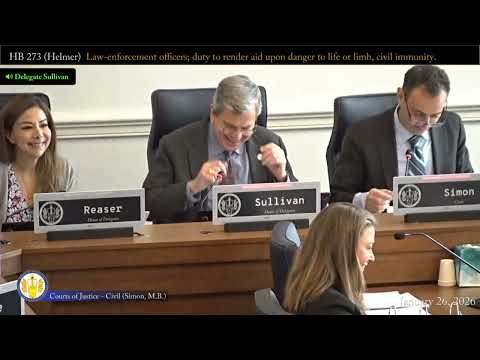
Subcommittee advances bill to codify officers’ duty to render aid, with immunity carve‑outs
Loading...
Summary
House Bill 273 would require law‑enforcement officers to render life‑saving aid in limited circumstances, create a carve‑out from liability except for gross negligence or willful misconduct, and request statewide training standards; the subcommittee reported the bill (7–2) after testimony raising concerns about the undefined term 'willful misconduct.'
Delegate Helmer told the Civil Law Subcommittee HB 273 "is a bill we've worked closely with law enforcement on" to "set clear common sense expectations for life saving care when a law enforcement officer encounters an individual that is suffering from a serious bodily injury or life‑threatening condition." He said the measure would create a duty to render aid in a narrowly tailored set of circumstances and would provide civil‑immunity for officers who render aid in good faith, except for "gross negligence or willful misconduct."
Members pressed how the proposal would interact with existing civil‑immunity law and the doctrine commonly described as qualified immunity. Delegate Dougie Ballard asked whether the bill takes a position on qualified immunity; Helmer replied it “doesn't take a position on qualified immunity” and instead “articulates a specific duty to render aid in a specific set of limited circumstances.” Counsel noted that the phrase "gross negligence or willful misconduct" is the same language historically used in civil‑immunity provisions but acknowledged that "willful misconduct" is not separately defined in the bill.
Representatives of the Virginia State Police Association said they support officers rendering aid but warned the undefined "willful misconduct" standard risks more litigation. David Osman, counsel for the association, told the committee "the key problem that we see with the bill is that willful misconduct is an undefined term" and argued that plaintiffs could plead a lesser standard and force issues to a jury. He also urged clearer, standardized training so officers have specific guidance. Elizabeth Hobbs of the Virginia Sheriffs Association testified that sheriffs consider this to reflect duties they already perform but welcomed the clarity and training component.
Committee members who spoke in favor said the bill would codify responsibilities many officers already follow and would establish uniform training through DCJS. After discussion and public testimony, the subcommittee voted to report HB 273 to the full committee on a 7–2 vote.
The bill now moves to the full committee for further consideration.