Get Full Government Meeting Transcripts, Videos, & Alerts Forever!
Get email alerts on the Water Rates topic
No spam. Unsubscribe anytime.
Fulshear hears multi-year water and wastewater rate options as city plans major infrastructure borrowing
Summary
Consultants and city staff presented a five-year rate study Nov. 18 that ties much of the proposed water and sewer rate increases to $212 million in planned capital projects and new debt; council asked for additional scenarios and delayed any vote until a future meeting.
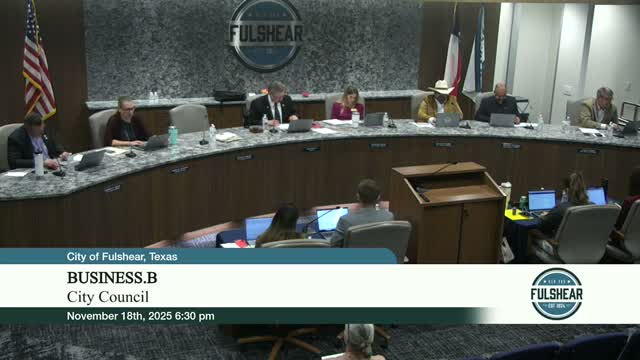
Fulshear — City consultants and staff told the City Council on Nov. 18 that a large share of forthcoming water and wastewater rate increases are driven by planned capital projects and related debt, and they presented three options for how the city could structure sewer increases and modest water base-fee changes.
"When the well is dry, we learn the word water," consultant Nalisa Hedden told council as she framed the city’s challenge in both regulatory and financial terms. Hedden said the rate study uses a five-year revenue-requirement approach that layers operations, maintenance and debt service and relies on the American Water Works Association methodology the city contracted to use.
Why it matters: staff and the consultant said recent and anticipated projects — the water and wastewater master plan was cited at about $212,000,000 in capital projects — plus limited collections from historical capital-recovery/impact-fee agreements mean the city expects roughly 80% of some new debt to be repaid through rates rather than by impact fees. That shifts much of the near-term burden to utility customers, council members were told.
What was proposed: the presentation included an example water base-fee change for a common residential meter from $13.44 to $14.11 for 2026 (less than $1 base increase) and several multi-year volumetric-tier adjustments. For wastewater Hedden and staff presented three rate options that vary how much of the increase is recovered through higher base charges versus volumetric charges; staff showed sample customer bills under each option so council could compare impacts by usage profile.
Council questions and next steps: council members repeatedly asked for more granular scenarios and supporting data, including (1) winter-average consumption breakdowns used for sewer billing, (2) projected impact-fee collections by neighborhood (Fulshear/Fulshear Lakes, Tamarind West, other out-of-city wholesale customers), (3) a topographic map showing proposed pipeline work and line depths, and (4) annual monitoring of system pressures and results after the recently completed downtown and Pecan Knoll projects. City staff said they would run the additional scenarios and return with more detail; no ordinance or formal vote on rates was taken on Nov. 18.
Direct quotes from the meeting capture the consultants’ framing and staff caveats: "The major driving force for the rate increases we are going to talk about is infrastructure," Hedden said. City staff also characterized the Pecan Knoll plant work as operational when discussing system redundancy: "The plant is entirely operational," staff said during the update.
What to watch: staff indicated they will bring refined scenarios and additional exhibits back to council, likely in December, including the winter-average calculations and updated impact-fee projections. The council emphasized it wants the public to see clearer, localized examples of how the options affect different neighborhoods and commercial users.
All figures and policy options in this article are taken from the Nov. 18 presentation and public record; specific ordinance language, a final chosen option, or a formal vote on rates was not included in the record of this meeting.