Get Full Government Meeting Transcripts, Videos, & Alerts Forever!
Get email alerts on the Permitting And Development topic
No spam. Unsubscribe anytime.
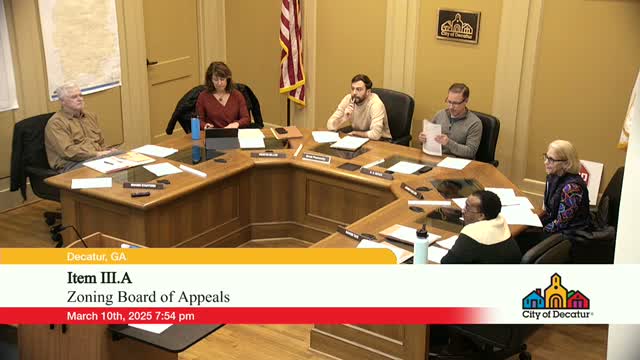
Decatur ZBA approves size variance for ADU at 206 Fayetteville Rd after staff admits permitting error
Summary
The Zoning Board approved a variance to exceed the maximum accessory-structure size for an ADU at 206 Fayetteville Road after staff acknowledged an error in plan review left an invalid permit in place; board members cited good-faith reliance on staff guidance and construction progress in granting the variance.
The City of Decatur Zoning Board of Appeals approved March 10 a variance to exceed the maximum accessory-structure size for an accessory dwelling unit at 206 Fayetteville Road after staff acknowledged a review error that allowed the project to proceed under an invalid interpretation of the Unified Development Ordinance (UDO).
The applicant and their contractor told the board the building permit had been issued and the structure had passed multiple inspections before a stop-work order issued when staff identified a square-footage discrepancy. The contractor said the project had required "8 months" to get to construction and that relocating or redesigning the building at this stage would impose significant additional cost and delay.
Project manager John Prier described conversations in December 2023 with a zoning official about allowable square footage and recounted that the team adjusted drawings and paid for revisions based on that guidance, citing UDO guidance (he referenced "section 6-8-3"). Multiple supporters and the property owner said they relied on staff guidance and inspections as the work proceeded.
Staff acknowledged a review error, and one staff speaker explained that, under Georgia case law as applied locally, an issued building permit that violates municipal ordinance is not itself a source of vested rights; the board nonetheless weighed the applicant's reliance and the stage of construction when deciding.
Board members were split in tone: several expressed frustration that permitting errors occur and concern about setting precedent, while others said it would be unfair to the property owner who relied on staff and had nearly finished construction. A motion to approve the variance (size only; height was not part of the request) was made, seconded and carried by voice vote.
The board approved the variance with the chair noting staff should review its processes to prevent future errors; staff and applicants were advised to coordinate follow-up steps and any necessary documentation.
Next steps: staff will document the cause of the permitting error and advise the applicant on permit finalization and any related enforcement or record corrections.