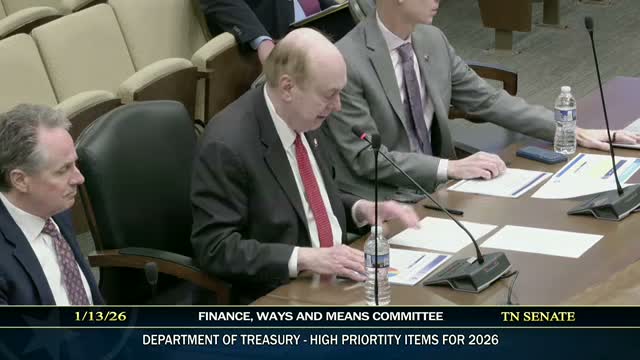
Treasurer says Tennessee pension system is well funded but flags risks if investment returns falter or laws revert hires
Loading...
Summary
State Treasurer David Lillard told the Senate Finance, Ways and Means Committee that Tennessee’s consolidated retirement system is among the nation’s best-funded plans, with roughly 69% of annual benefits coming from investment earnings, but warned bills reverting employees back to the legacy plan could create large fiscal exposure.
State Treasurer David Lillard told the Senate Finance, Ways and Means Committee on Jan. 13 that the Tennessee Consolidated Retirement System (TCRS) is “very well funded” and among the highest-funded state systems nationally, but that lawmakers must be cautious about proposals that could shift employees from the hybrid plan back to the legacy plan.
Lillard said the Treasury manages roughly $132.3 billion in running balances and that TCRS is the largest fund at about $75.7 billion. He told the committee that, in fiscal year 2025, TCRS paid about $3.42 billion in retirement benefits to roughly 164,000 retirees and that about $2.37 billion—roughly 69 cents of every dollar—came from investment earnings rather than employee contributions or current employer/taxpayer dollars.
The treasurer said the hybrid plan, enacted in 2014, has grown substantially and now includes more participants than the legacy plan in some state categories; the hybrid plan’s stabilization reserve and the state’s prior extraordinary contributions helped the system’s funded ratios. Lillard highlighted investment performance since 1978 and cited a 10.2% nominal return in the most recently concluded fiscal year.
Why it matters: reliance on investment earnings makes the system sensitive to market conditions. Lillard warned that bills restoring certain groups to the legacy plan could create substantial long-term fiscal costs, offering an illustrative fiscal note of about $24.3 billion if hypothetically applied broadly. He urged lawmakers to consider the long time horizons and liability impacts when drafting or voting on pension-related legislation.
Committee members pressed Lillard and Chief Investment Officer Michael Breakbill on sustainability and on the possible effect of Federal Reserve rate changes; the treasury officials said the investment-dependence is typical for well-funded plans, acknowledged market risk, and emphasized ongoing fiduciary oversight. Lillard also said Tennessee has consistently made required actuarial contributions and that prior legislative and gubernatorial contributions materially improved funded status.
The committee did not take formal action on legislation during the presentation; the treasurer’s remarks were informational and intended to guide future legislative consideration of pension-related bills.