Get Full Government Meeting Transcripts, Videos, & Alerts Forever!
Get email alerts on the Property Taxes topic
No spam. Unsubscribe anytime.
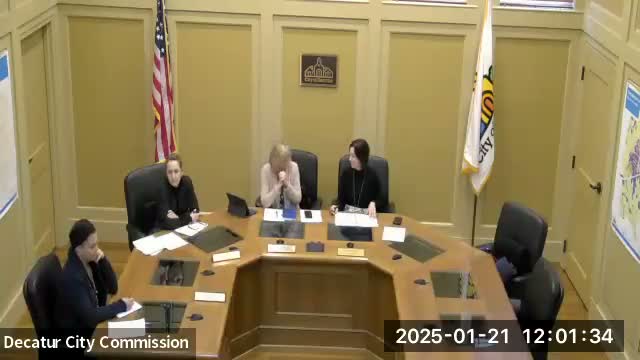
Decatur holds public hearing on House Bill 581; opt‑out decision postponed after resident testimony
Summary
Decatur officials heard residents’ personal stories and questions about House Bill 581’s ‘floating’ homestead exemption—covering how the cap works, who it affects, and potential revenue and bond‑rating consequences. No vote was taken; more hearings are scheduled before the city decides whether to opt out.
The Decatur City Commission held a public hearing on House Bill 581 on Jan. 27, 2026, to gather resident input before deciding whether the city will opt out of the state’s new "floating" homestead exemption. City staff explained how the law caps annual taxable‑value increases for owner‑occupied homesteads to the rate of inflation and noted a two‑month window for local entities to act.
City Manager Ms. Arnold told the commission that "House Bill 581...was passed by the General Assembly in 2024 and then approved by statewide referendum," and explained that the exemption limits increases in taxable value for residential homesteads to the CPI (or another inflation measure chosen by the state) and resets to assessed value on a change of ownership. She said the school system and city each must decide separately and warned that if an entity takes no action it remains opted in permanently; she also flagged potential credit‑rating concerns and recent local increases in exemptions.
The hearing centered on first‑hand accounts of assessment and affordability pressure. Spencer Hostetter, a Decatur resident, said he spoke for the "55.4% of the Decatur voters" who supported the measure and urged the commission not to opt out, arguing the policy "keeps [tax increases] from being exponential" and that revenue can still be realized as properties change hands. John Phillips, another resident, described a 36% assessment increase this year that produced an escrow shortfall of about $3,800 and raised his mortgage payment by roughly $660 per month; he told the commission that repeated large assessments are driving longtime residents to consider leaving Decatur.
Commissioners and staff focused on tradeoffs. Mayor Pro Tem Tony Powers urged county‑level review of how properties are assessed in DeKalb County, saying assessment disparities contribute to perceived unfairness. Commissioner Walsh said the decision is "complicated" and must be iterative and transparent given Decatur’s high residential tax base and its millage‑rate cap; she suggested exploring commercial growth and other revenue options. Commissioner Dunstanberry pressed staff on the mechanics of the countywide floating sales tax (FLOST), and Ms. Arnold clarified that a county sales‑tax backfill would only be possible if every taxing entity in DeKalb chose the same opt‑out posture, and that the FLOST revenue would be limited to backfilling capped property‑tax revenue.
City staff also warned of fiscal consequences: Ms. Arnold said limiting the city’s ability to capture taxable‑value growth could affect the city’s revenue and potentially its bond rating because the city issues long‑term debt for school projects. Staff estimated that school taxes account for roughly "60 to 65%" of a typical property tax bill, meaning differing decisions between the school system and the city could create inconsistent values on tax bills.
The commission did not vote. Mayor (unnamed) closed the public‑comment portion after hearing from multiple residents and said the commission would hold additional hearings, including a city commission meeting later that evening, before making a decision.
What’s next: the city will continue the public‑hearing series to collect more input and additional analysis of fiscal and equity tradeoffs before any formal opt‑out resolution is introduced.