Get Full Government Meeting Transcripts, Videos, & Alerts Forever!
Get email alerts on the Conservation Budget topic
No spam. Unsubscribe anytime.
Wildlife department seeks support for hatchery, range and access projects; highlights federal match and online licensing
Summary
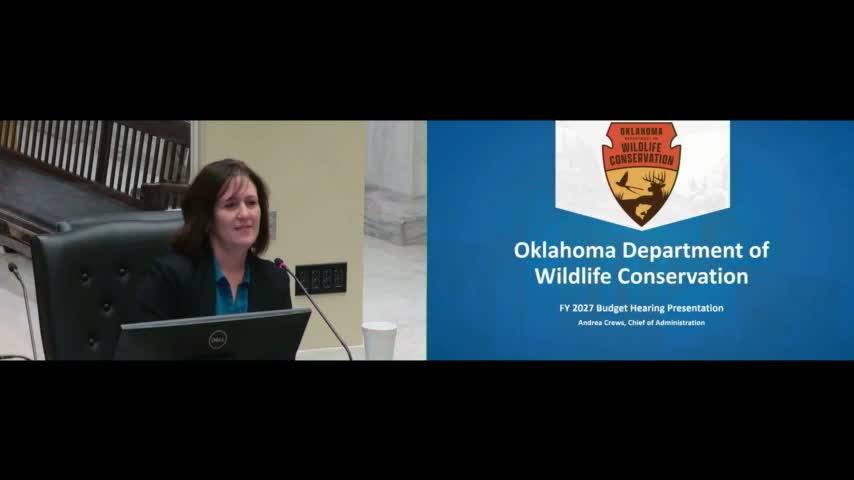
Andrea Cruz, chief administrative officer of the Oklahoma Department of Wildlife Conservation, briefed the appropriations subcommittee on agency priorities including phased hatchery renovations, a slate of shooting‑range upgrades, boating access projects and an online licensing contract; she said the department is primarily funded by user fees and federal Wildlife and Sport Fish Restoration programs.
Andrea Cruz, chief administrative officer of the Oklahoma Department of Wildlife Conservation, told the House appropriations subcommittee the agency manages more than 1,600,000 acres of wildlife management areas, operates four state fish hatcheries, and relies on a user‑pay funding model rather than general tax appropriations.
Cruz said the department has 374 employees and described performance metrics that guide her budget: targets for certified hunters/anglers, increasing boating and fishing access projects, keeping vacancies under 7% and limiting the share of public interactions that result in citations. She emphasized large multi‑year capital needs, naming Manning Fish Hatchery (phase 2), Cherokee WMA low‑water crossing replacement, the Watonga dam renovation and a multi‑decade Drummond Flats wetland restoration as near‑term priorities.
The department is carrying a portfolio of shooting‑range upgrades and noted that a change in federal rules allowed the state to leverage Pittman‑Robertson funds for range projects; Cruz said the match can be favorable (she cited roughly a 9:1 federal‑to‑state match on eligible range work), enabling the department to stretch state dollars for improvements. Cruz listed completed projects in FY25 (shooting ranges at Atoka and Packsaddle, boating access at Stroud Lake and Lake Ellsworth, and dam work at Lake Jack Beaver) and ongoing projects in communities including Newcastle, Choctaw and Yukon for 'close‑to‑home' fishing docks.
On licensing technology, Cruz said the department uses a third‑party vendor (Brandt) for online license sales and renewals and that the contract — established after a competitive process — runs for multiple years with procurement/renewal work expected before 2029. She invited members to report specific user complaints so the agency and vendor can address usability issues.
Assistant Director Nels (identified in the hearing) answered technical questions about nonresident licensing changes and fisheries programs. Nels said a reprogramming of nonresident licensing raised net revenue (early‑year sales counts fell while revenue rose) and estimated net revenue gains in the early years at roughly $6–10 million (lower than some initial projections of $10–12 million). He also recounted the history of the paddlefish caviar program, noting that at its peak some years produced several million dollars of revenue but that global market changes — particularly increased farming of paddlefish abroad — substantially reduced commercial returns and the agency has shifted to a statewide research and restoration focus for paddlefish efforts.
On nuisance animals, the department clarified that feral hog control is administered by the Department of Agriculture, though the Wildlife Department offers a free feral hog endorsement (night shooting exemption) for landowners or designees in the licensing system and explained that federal Wildlife Services and USDA‑funded trapping/helicopter operations are used in focused control areas.
Cruz closed by noting the department’s large capital portfolio is partly why reported expenditures and budget lines can appear elevated in a single fiscal year — roughly one‑third of the budget is capital and projects are multi‑year — and asked members to visit agency facilities and engage with staff about local needs.