Oklahoma Lottery Commission tells appropriations panel teacher empowerment fund growing; calls for iLottery consideration
Loading...
Summary
Lottery Director Jay Finks told the House appropriations subcommittee that legislative changes since 2018 and strong sales have increased funds for education; the first $65 million annually goes to a statutory education formula and revenues above that feed the Teacher Empowerment Fund, which now holds an estimated low‑forties million dollars available for teacher stipends.
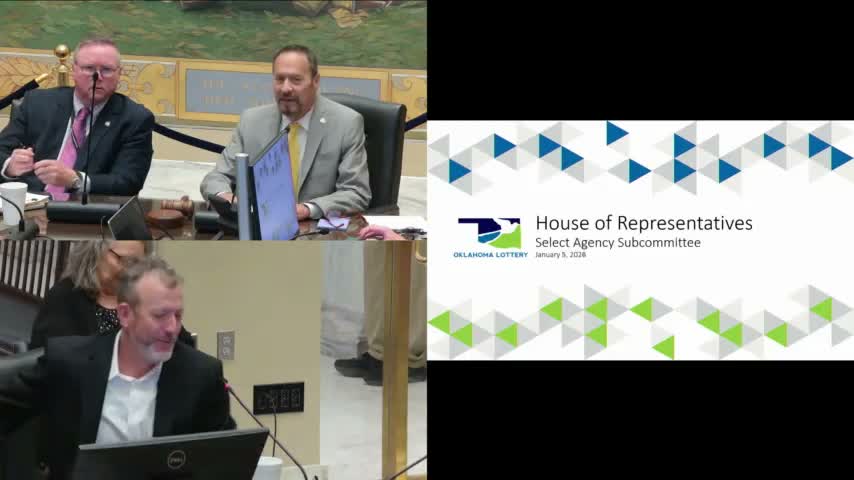
Jay Finks, executive director of the Oklahoma Lottery Commission, told the House Appropriations and Budget Select Agency Subcommittee that the lottery’s revenue model has shifted since a 2017 law change and that growth since FY17 has produced larger contributions for education. "When someone spends a dollar, we pay our prizes, we pay all of our administrative expenses and everything left goes to education," Finks said as he explained the switch to a net‑profit model that began in 2018.
Finks told members the commission’s ten‑year overview shows a post‑2017 rebound from a FY17 sales low of about $151,000,000 and projected that roughly $82,000,000 would be returned to the state in the current year. He said the first $65,000,000 of annual lottery receipts is allocated by formula — roughly 45% to common education and 45% to higher education, with the remainder to career and consolidation/teacher retirement uses — and that any dollars above $65,000,000 enter the Teacher Empowerment Fund (TEF).
The TEF is intended to underwrite teacher certification programs and stipends administered through the State Department of Education. Finks said the commission expects to deposit an estimated $18,000,000 into the TEF this year and estimated the fund balance is presently in the "low forties" of millions after payouts; he also reported approximately $12,000,000 in FY26 applications and that about 53% of that application amount had been fulfilled, representing roughly 1,700 teachers in about 110 districts.
Committee members asked whether teachers and districts must apply to access TEF money and whether there is a district cap. Finks said schools design certification programs, submit them to the State Department of Education for approval, and then teachers in approved programs can receive stipends; he said there is an approximate limit of participation per district (about 10% of teachers) but deferred detailed program rules to the State Department of Education and offered to provide the committee with a breakdown of program parameters.
Finks also reviewed operating metrics for the commission: about 31 full‑time employees, a statutory administrative spending cap of 3% of sales (the commission projects spending at about half that cap this year), retailer commissions around 6%, and an overall return to the state of roughly $0.24 on each dollar of sales.
Looking to future revenue options, Finks urged lawmakers to consider authorizing iLottery (online ticket sales) and noted that sports betting is likely to be a major policy topic in an upcoming session. He estimated an iLottery model could add roughly $15–20 million in annual net revenue to the bottom line but cautioned that authorizing online wagering would require legislative action and that compact exclusivity with tribal gaming interests would need to be resolved as part of any package.
No formal action or vote occurred during the hearing; Finks’ presentation closed with the commission offering to supply slides and to coordinate with the State Department of Education to increase awareness of the TEF among districts.