Get Full Government Meeting Transcripts, Videos, & Alerts Forever!
Get email alerts on the Hydrology topic
No spam. Unsubscribe anytime.
Ojai Basin levels rising; consultant assessment of spreading grounds due next month
Summary
At an Ojai Basin Groundwater Management Agency meeting, a technical briefing showed recent rises in key-well levels and measured surface flows; Rincon Consultants is assessing spreading-ground efficiency and will deliver a report to the county next month.
Speaker 3 presented a technical update on Ojai Basin hydrology on March 22, reporting recent rises in groundwater levels and measured creek flows, and said a consultant report on the spreading grounds is imminent.
Speaker 3 said the basin has seen about 8.64 inches of precipitation on the valley floor and 14.72 inches on the ridge this season and that the key monitoring well is at 100.24 feet, which the presenter described as “about 81% base in capacity or 64,800 acre‑feet” based on linear regressions. He told the board the key well is up roughly 7 feet from its January nadir.
The presentation included surface‑flow measurements across several creeks: Gridley at 0.37 cubic feet per second (CFS), Thatcher at 0.04 CFS, Reeve at 0.38 CFS, Montgomery at 0.45 CFS and San Antonio Creek outflow at 4.95 CFS. Speaker 3 said much of the inflow observed at confluences is infiltrating into the basin and that the purpose of the spreading grounds is to capture and divert that natural flow into recharge when possible.
Rincon Consultants, Speaker 3 said, is conducting an assessment for the county of the spreading‑grounds’ efficiency and condition and is expected to provide recommendations in a report next month on potential improvements to infiltration and recharge capacity.
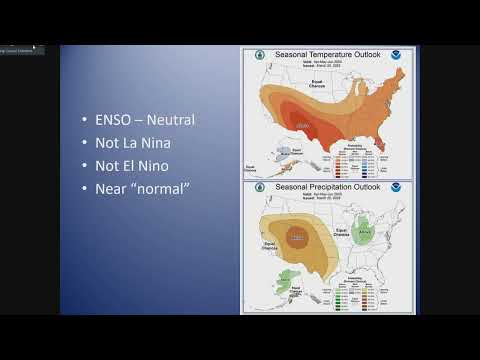
On longer‑range conditions, Speaker 3 summarized federal and regional outlooks: this year’s El Niño–Southern Oscillation is predicted to be neutral (neither El Niño nor La Niña), and NOAA seasonal outlooks show near‑normal precipitation and temperature prospects for April–June 2025, though the regional long‑term drought indicator still shows persistent drought conditions. “These products appear to match what we see in the field,” he said.
The presentation also noted localized observations, including tannic (dark) water and algae in slow‑moving reaches and a report of wildlife activity near a tent beneath a bridge; Speaker 3 described a carcass found near a campsite as “the most bizarre thing,” illustrating on‑the‑ground field observations that accompany the monitoring data.
The board did not take formal action on the presentation; Speaker 3 and staff said they will continue monitoring conditions and will watch for the Rincon report to inform any operational recommendations for the spreading grounds.