Get Full Government Meeting Transcripts, Videos, & Alerts Forever!
Get email alerts on the Water Monetization topic
No spam. Unsubscribe anytime.
Chester receiver delays water-asset RFP, blames Chester Water Authority litigation for months-long stall
Summary
Receiver Vijay Kapoor told the MRAC on Aug. 12 that repeated legal filings and delays by the Chester Water Authority have forced a 60-day extension of the city's water-asset RFP to Nov. 3, 2025; he said the RFP requires assets remain publicly owned and urged expedited court compliance to limit ratepayer costs.
Vijay Kapoor, the court-appointed receiver for the city of Chester, said at the Municipal Financial Recovery Advisory Committee meeting on Aug. 12 that he is delaying the city's request-for-proposals (RFP) for water-asset monetization by 60 days to Nov. 3, 2025, citing repeated litigation tactics by the Chester Water Authority (CWA) that have stalled document production and driven up legal costs.
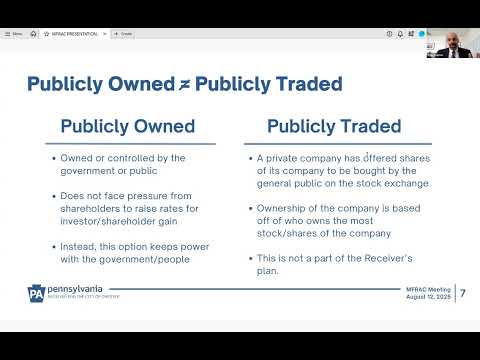
Kapoor said the RFP process is designed to produce revenue for the city's plan of adjustment while keeping ownership of the water system in public hands. "The water assets must remain publicly owned," he said, adding that qualified bidders will be required to demonstrate experience managing water systems and to comply with nondisclosure rules and relevant security laws.
Why it matters: The monetization effort is part of Chester's bankruptcy recovery plan to raise funds, satisfy creditors and restore sustainable city services. Kapoor warned a Supreme Court ruling adverse to the city could make the financial situation worse and may force deep cuts if alternative revenue streams are not found.
What caused the delay: Kapoor outlined a months-long dispute in which CWA repeatedly filed challenges in the U.S. Bankruptcy Court and, he said, withheld records the court had ordered produced. He told the committee that CWA produced more than 12,000 documents only the morning of a scheduled hearing, after a motion to enforce production was filed. "They dropped 12,000 documents on us the morning of the hearing," Kapoor said, characterizing the timing as "gamesmanship" that wasted time and increased legal bills.
Costs and legal staffing: Kapoor said receiver-side attorneys spent fees exceeding $130,000 over a three-month period responding to CWA's filings; he said he lacks full visibility into CWA's own legal spending but noted SafeCWA announced it had retained an appellate firm in Arlington, Va., and questioned the likely expense to ratepayers.
Court limits on communications: Kapoor said the bankruptcy judge ordered CWA to stop communications that could harm asset value or the RFP process, while allowing truthful commentary about the case. He said letters sent by CWA's solicitor and outside firms to potential bidders that characterized the RFP as a "sham" violated the court's stay and prompted relief from the judge.
Rates and service concerns: Kapoor emphasized that keeping assets publicly owned is intended to protect ratepayers; he cited prior Pennsylvania cases under Act 12 and PUC-authorized private purchases where he said rates rose substantially. He acknowledged rates are rising generally and said the RFP's objectives include improving access to capital, preserving public-sector employment and encouraging cost-effective capital reinvestment.
Next steps: Kapoor said the city will continue the RFP process despite the pending Pennsylvania Supreme Court case over ownership questions and recognized bidders understand the process may be affected by that decision. "We need to act in good faith and allow this RFP process to move forward," he said, arguing the city cannot wait indefinitely while fiscal pressures mount.
The committee did not take a formal vote; the receiver announced the administrative decision to extend the RFP response date and reiterated the requirement that any resulting transaction preserve public ownership of the water system.