Get Full Government Meeting Transcripts, Videos, & Alerts Forever!
Get email alerts on the Economic Development topic
No spam. Unsubscribe anytime.
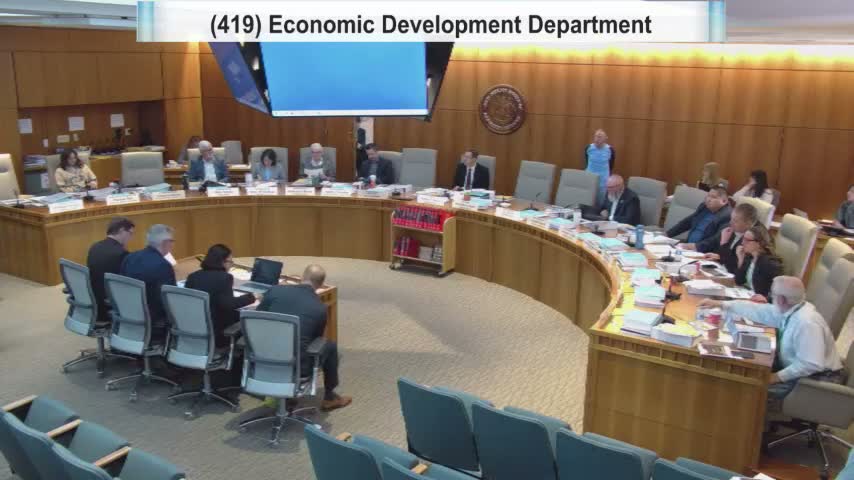
Committee backs LFC recommendations after EDD outlines DARPA match, site readiness and major tech projects
Summary
The Economic Development Department told legislators it is pursuing a $49.3 million state match to leverage DARPA funds, has characterized roughly 47 development sites and cited near-term projects (Pacific Fusion, Project Jupiter, Castilian hypersonics) that together could generate large economic impact; the committee adopted the LFC recommendation after extensive questioning on infrastructure and workforce.
Secretary Rob Black told the Appropriations & Finance Committee the Economic Development Department's FY27 operating budgets are largely agreed between the executive and LFC, while larger differences appear in special appropriations. He framed EDD's strategy around a science-and-technology roadmap that prioritizes advanced energy, advanced computing, space and defense.
Black described the state's site readiness initiative, saying EDD has characterized about 47 sites for development (two on tribal land) and will accept another round of applications. He said site readiness assessments include analysis of water, power, rail access and workforce proximity; EDD plans to use characterization results to prioritize investments in predevelopment infrastructure.
On federal matches, EDD and DFA staff described a DARPA opportunity and a state request of $49.3 million to unlock federal funding for quantum validation and testing. "Those will be matched by DARPA," a deputy explained, adding that the LFC spread the match over multiple years while the executive included the full ask.
Black highlighted three private-sector projects tied to the state's investment strategy: Pacific Fusion (an $8 million lead investment cited, with projected longer-term impact), Project Jupiter (a large data center project), and Castilian hypersonics (a defense contractor project). He said these deals illustrate why the state is aligning incentives, workforce training and investment funds.
Committee members challenged EDD on how it funds infrastructure for rural sites and industrial parks. Black and DFA staff pointed to site readiness grants, LIDA and trade-port funds (including a $50 million trade-port fund) as sources of capital for roads, utilities and environmental reviews. For jobs and training, the department cited JTIP (jobs training incentive program) and new workforce efforts like CNM's quantum boot camp.
On Project Jupiter's water and energy impacts, EDD said the project plans a closed-loop water system and that electrical infrastructure is being funded by the developer, not ratepayers. The department emphasized coordination with local governments, the State Investment Council and federal partners to align permitting and incentives.
After multiple rounds of questioning on incentives, water and rural access, the committee moved and approved the LFC recommendation for EDD by voice consent.