Get Full Government Meeting Transcripts, Videos, & Alerts Forever!
Get email alerts on the Food Services topic
No spam. Unsubscribe anytime.
Food services overview: meal-account balances, MySchoolBucks revenue and procurement pressures
Summary
Budget liaisons reported that the district’s food services program is self-funded, carries a $17,962 negative student-account balance and saw $450,199.40 in MySchoolBucks payments Aug. 28–Jan. 16; proposed food and milk spending is projected at about $700,000 next year.
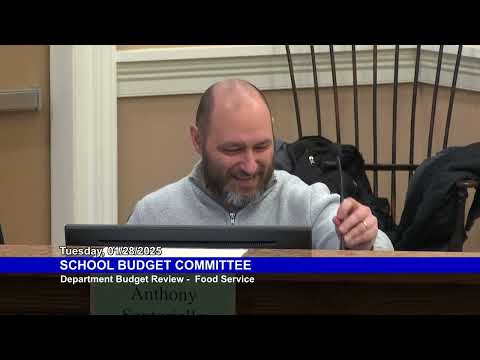
MERRIMACK, N.H. — Committee members heard a detailed review of the Merrimack School District’s food services program, including account balances, online payment totals and the department’s procurement and staffing pressures.
A committee liaison summarized a meeting with food-services leadership, saying the program is self-funded and reimbursed by the federal government for free and reduced meals. He reported a current negative balance in student meal accounts of $17,962 and positive student-account balances of $82,536. “The current negative balance from the start of school until January 16 is $17,962,” he said.
The liaison also reported nearly $450,200 in online deposits via MySchoolBucks between Aug. 28 and Jan. 16: “The total payment on account from MySchoolBucks this year from August 28 until January 16 is $450,199.40,” he said. Committee members noted MySchoolBucks is now the primary payment method; cash and checks remain available.
Members questioned the allocation of roughly $95,000 labeled “lunch support salaries” charged to the general fund rather than the food-service enterprise fund. Committee members were told those positions are lunch monitors who report to building principals and are treated as general-fund support staff rather than food-service workers.
The liaison explained proposed line-item changes: the district proposes $65,000 for paperware/cleaning supplies (previously budgeted at $75,000) and forecast about $700,000 for food and milk to cover milk, juices, meats and produce. He also described a $9,500 annual point-of-sale service contract covering parts, labor and loaners for terminals deployed across six schools.
On procurement, staff described the trade-offs of low-bid contracts and using buying collaboratives to stabilize prices. The liaison said leftover food is minimized, with elementary production kitchens counting meals before dispatch and high-volume schools replenishing lines as needed.
Committee members asked whether federal budget cuts could threaten reimbursements; the food-services representative said he knew of no direct impacts but would keep the committee informed.
What’s next: Committee members requested clarifications on staffing classifications and the rationale for charging certain positions to the general fund rather than the food-service account.