
Legal counsel briefs Merrimack budget committee on New Hampshire right-to-know rules
Get AI-powered insights, summaries, and transcripts
Subscribe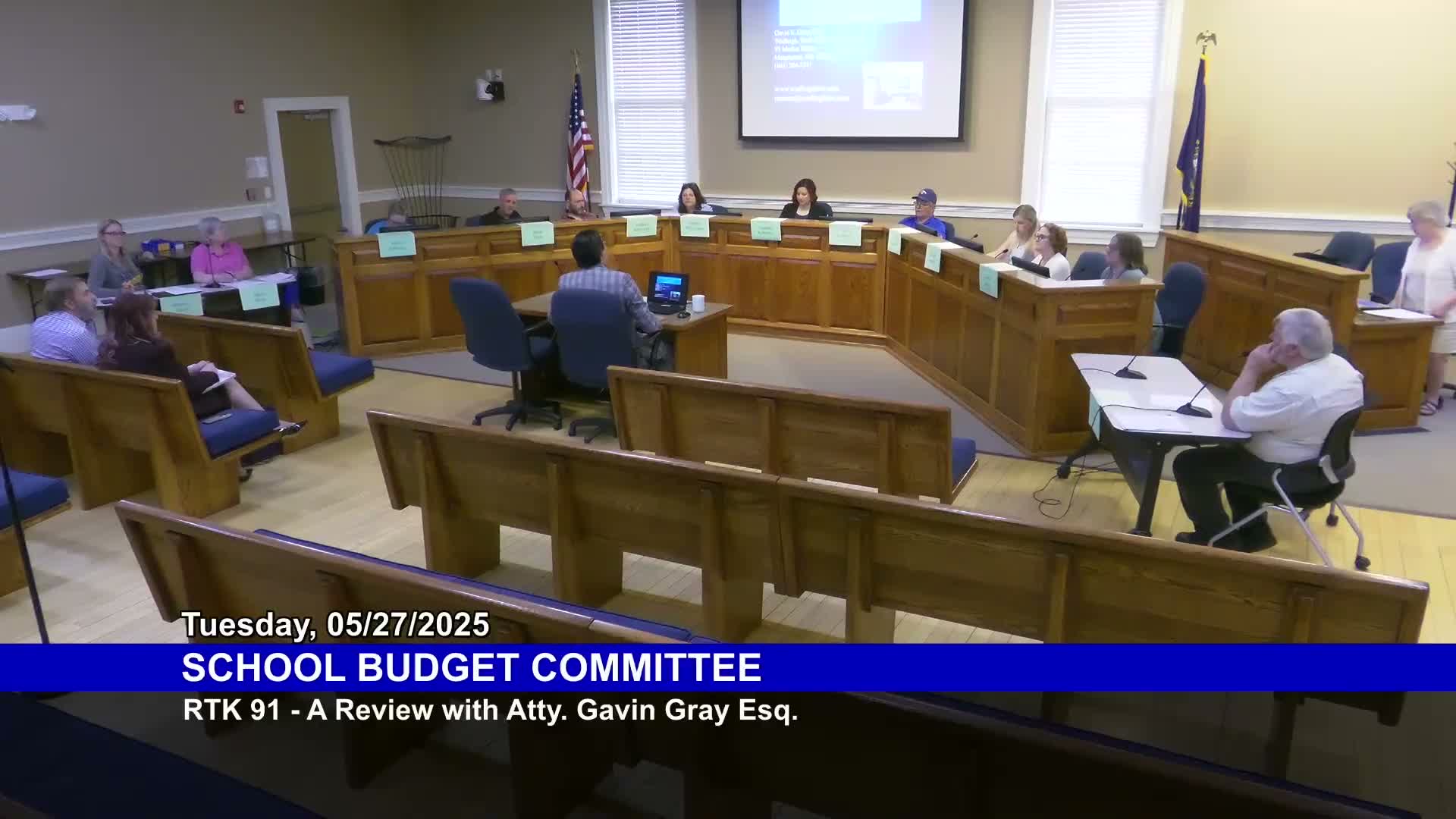
Summary
The committee heard a comprehensive presentation from its legal counsel on New Hampshire's right-to-know framework (RSA 91-A, Part I Article 8) and asked questions about emails, texts, social media and archival responsibilities. Counsel said ambiguities should be resolved in favor of disclosure and offered to share slides after the meeting.
Attorney Gray, serving as the committee's legal adviser, reviewed New Hampshire's constitutional and statutory framework for public access to records and meetings and answered members' questions about electronic communications, social media and document retention.
Gray opened by citing the state constitution's guarantee of public access (Part I, Article 8) and the implementing statute RSA 91-A, telling members that the law carries a presumption of disclosure: "Openness in the conduct of public business is essential to a democratic society," and that ambiguities are construed in favor of disclosure. He said the burden falls on a public body to prove an exception when withholding records.
Gray explained three distinct communication categories a committee can have: an open public meeting, a nonpublic session that is part of a public meeting (when enumerated exceptions apply), and informal "non-meetings" that do not require minutes. He said a meeting typically requires (1) a quorum and (2) contemporaneous communication among members about matters within the board's jurisdiction, and warned that sequential emails or coordinated messaging can create the functional equivalent of a meeting.
On electronic communications and records, Gray urged members to assume a record might be public and to preserve it accordingly. He recommended using SAU-assigned email accounts for committee business, archiving messages, and saving presentation files in accessible formats. On personal notes, he said there is an exception for private notes but they lose that protection if shared with others.
Social media guidance focused on intent and participation: a single member's comment on a public forum is usually private activity, he said, but if a quorum of members uses the same thread to discuss or coordinate around committee business it can amount to an unlawful meeting. He recommended archiving threads that have substantive discussions and suggested members avoid real-time coordination by text or group messages about substantive votes.
Members asked specific questions about group texts, whether presenter notes can be requested, the process for adjudicating voluminous requests, and whether records produced to a requester must be made public more broadly. Gray said the law firm typically reviews requests for responsiveness and privilege, that requesters may share what they receive, and that public bodies do not have to create new documents solely to respond to a request.
Gray told the committee he would email the slide deck and handouts and invited members to follow up with additional questions.
The committee followed the presentation with a lengthy Q&A about social media, accessibility, remote attendance in medical circumstances, and the practical steps the committee should take to remain compliant.
What happens next: Gray said he would email slides and materials to the committee and the chair indicated she would follow up on device guidance for members.